

Run a Tender Compliance Check on a Sliding Glass Partition
Quick project answer
Review focus: tender compliance check.
A sliding glass partition tender compliance check is a structured review that compares what the tender documents require with what each bidder actually offers. It is not a single form or a pass/fail stamp. It is a sequence of comparisons across drawings, specifications, finish schedules and coordination notes. For overseas project teams, the goal is to reduce ambiguity before award, not to rank suppliers on claims that cannot be verified from the submission.
This guide sets out an evidence-bounded method. Every recommendation below is tied to maintained product facts, visible submission evidence and project-specific drawing review. Where a requirement depends on the project, the correct action is to request confirmation rather than infer an outcome.
Why a Tender Compliance Check Matters Before Award
Project review term: tender compliance check.
Movable partition tenders often mix performance language, finish descriptions and layout assumptions in one document. Bidders respond in different formats, which makes side-by-side comparison difficult. A compliance check creates a common structure so that gaps are visible early.
The check also protects the project team. If a submission is silent on a coordination point, that silence should be recorded as an open item, not treated as agreement. The exact overhead route and support arrangement must be confirmed by the responsible project team from coordinated drawings.
Start With the Movement Route, Not the Panel Finish
Coordination scope: tender compliance check.
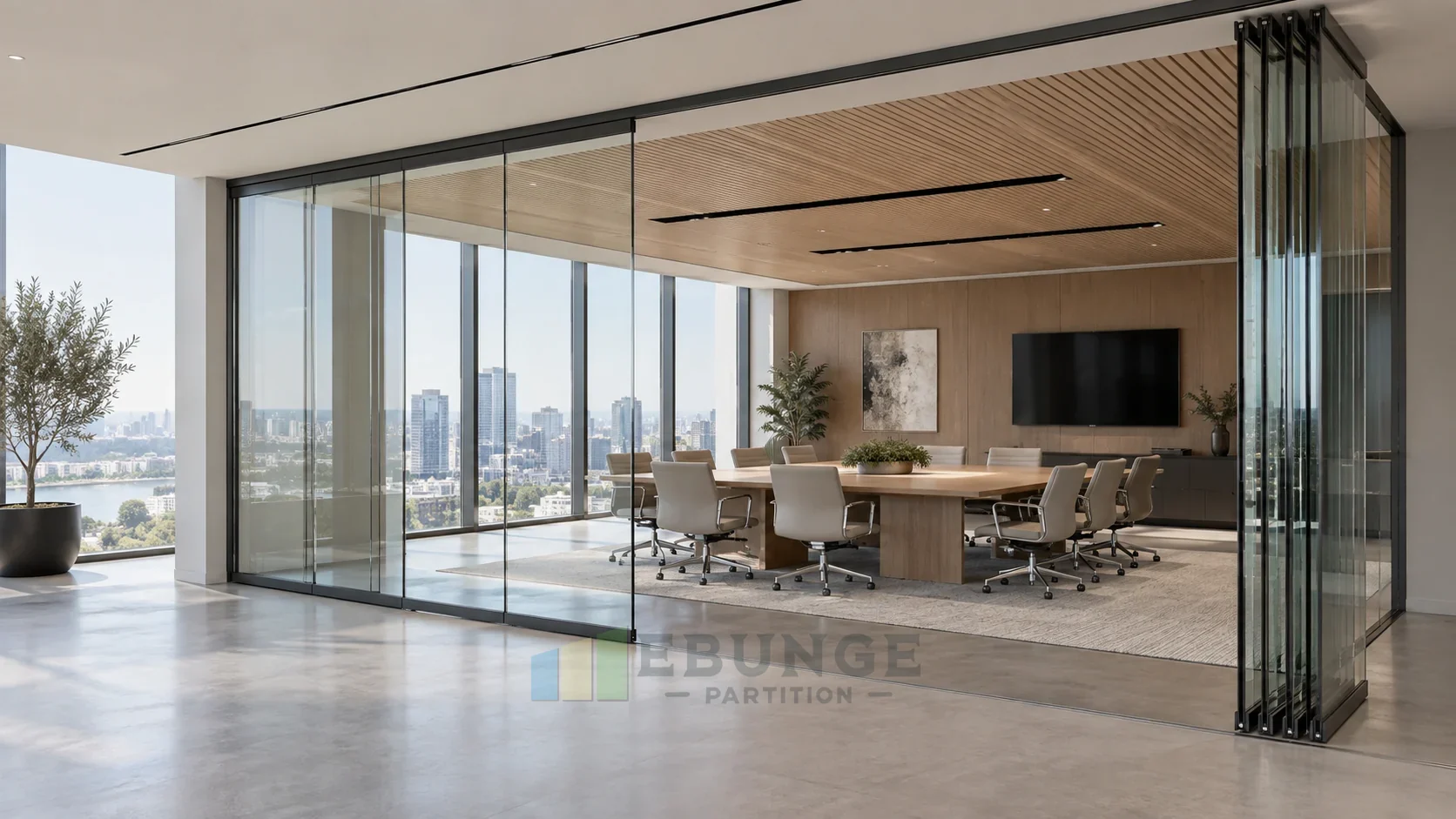
The most common early mistake is to begin with glass type or frame colour. A more reliable starting point is the movement route. EBUNGE movable wall panels are individually movable, suspended from a top track, cross the opening without a floor track, and park at a planned stacking position.
That description has direct tender consequences. The submission should show how panels travel from the closed position to the parking position, and whether the route is straight, turning or a combination. Straight, turning and stacking routes are reviewed from the layout, so the tender should include a layout that supports that review.
Questions to put to every bidder
- Which drawing shows the full movement route from closed position to parking position?
- Does the route include any turning section, and is it dimensioned on the layout?
- Where is the planned stacking position, and does it conflict with other services or finishes?
- Is the overhead route continuous and connected across the full travel path?
- Which items still require project-specific structural review before fabrication?
Build a Clause-by-Clause Evidence Map
Checklist focus: tender compliance check.
A compliance check becomes manageable when each tender clause is mapped to a specific piece of evidence. The evidence may be a drawing, a schedule, a finish reference or a written confirmation. If no evidence exists, the clause is open.
| Tender clause area | Expected evidence in submission | Status if missing |
|---|---|---|
| Movement and parking route | Layout showing straight, turning and stacking routes | Open item |
| Top-hung suspension concept | Drawing note confirming top-hung arrangement | Open item |
| Floor condition along partition line | Statement that no continuous floor track is used | Open item |
| Finish selection | Finish schedule referencing approved surface options | Open item |
| Pass-door requirement | Written confirmation of pass-door coordination | Open item |
| Project documentation | List of documents to be provided for review | Open item |
This table is a review tool, not a performance statement. The suitability of each route and parking arrangement depends on the approved layout, circulation, ceiling interfaces and operating sequence. Those remain project-specific and require separate confirmation.
Review Finish Schedules Against Confirmed Options
Review focus: tender compliance check.
Finish clauses are frequently written loosely, which makes compliance hard to judge. Confirmed finish options include laminate, melamine, fabric, leather, glass and other approved surfaces. A submission that proposes a finish outside that list should be treated as a clarification item.
Finish review should also separate appearance from performance. A finish sample shows appearance. Visible references can support layout discussion but do not verify hidden construction or performance. Those questions belong in a separate evidence request.

Finish schedule checks
- Does the schedule name the finish category for each panel face?
- Are glass areas described consistently with the framed or frameless system proposed?
- Are edge conditions and frame finishes described where applicable?
- Are any finishes proposed that fall outside the confirmed option list?
Handle Acoustic Language Carefully
Acoustic clauses are where tender documents most often drift into unsupported claims.
A compliance check should ask what evidence supports any acoustic statement in the submission. If the tender requires a specific rating, the project team should confirm how that rating will be demonstrated for the actual configuration, including the surrounding construction. Seals and acoustic concepts can be explained generically, but the project-specific result requires its own review.
Evidence note: a visible finish, photograph or drawing does not prove acoustic, fire, durability or structural performance. Treat any such inference as an open item until matching project evidence is provided.
Coordinate Pass Doors, Interfaces and Documentation
Pass-door requirements and project documentation can be discussed with the supplier during tender review. The compliance check should record whether the submission addresses them, and whether any interface with adjacent trades remains unresolved.
Interfaces matter because a movable partition rarely stands alone. Ceiling structure, adjacent glazing, floor finishes and fire or acoustic separations may all touch the partition line. The tender review should list these interfaces and note who is responsible for each.
Documentation to request
- A layout drawing showing the movement and stacking routes.
- A finish schedule aligned with the confirmed finish options.
- A written statement of any pass-door coordination requirements.
- A list of project-specific items requiring confirmation before fabrication.
- A clear point of contact for technical clarification during evaluation.
Common Compliance Check Pitfalls

One pitfall is treating a bidder’s silence as compliance. Another is comparing bids on price alone when the scope of evidence differs. A third is accepting a performance phrase without asking what supports it.
A fourth pitfall is assuming that a route shown on a marketing image matches the project layout. Routes must be reviewed from the application reference layout, because straight, turning and stacking conditions change the coordination requirements.
Frequently Asked Questions
What is a sliding glass partition tender compliance check?
It is a structured comparison between tender requirements and bidder submissions, using drawings, schedules and written confirmations as evidence. It records open items rather than inferring outcomes.
Do movable glass partitions need a floor track?
EBUNGE movable wall panels are top-hung and cross the opening without a floor track. The exact route, junction arrangement, continuous overhead path and parking position must be confirmed from the coordinated project drawings.
Can the tender check confirm acoustic performance?
No.
Which finishes can be reviewed in the tender?
Confirmed finish options include laminate, melamine, fabric, leather, glass and other approved surfaces. Finish samples show appearance, not durability or acoustic behaviour.
How should pass doors be handled?
Pass-door requirements can be discussed and recorded as a coordination item. The submission should state whether the requirement is addressed and what remains open.
What should happen when evidence is missing?
The clause should be marked as an open item and clarified before award. Missing evidence should not be treated as agreement or as proof of compliance.
Conclusion and Next Step
This approach keeps the evaluation fair and reduces surprises after award.
To discuss pass-door requirements, project documentation or a layout review for your tender, contact the EBUNGE team. You can also review the framed movable glass partition range, browse products, explore solutions, check applications, or use the engineering resources to prepare your compliance questions.