

How Room Scheduling Rules Shape for Glass Partition Changeover Policy
Quick answer: movable glass partition changeover policy
Review focus: glass partition changeover policy.
A movable glass partition changeover policy is the written set of rules that tells a facility team how, when and by whom a flexible room is reconfigured between bookings. It is not a product specification. It is an operating agreement that sits between the room schedule and the partition system. Because EBUNGE panels are individually movable, top-hung and travel without a continuous floor track, the changeover policy can focus on sequence, parking position and route review rather than on floor hardware. This article explains how scheduling rules shape that policy and where project-specific confirmation is required.
Why Scheduling Rules Come Before Hardware Decisions
Project review term: glass partition changeover policy.
Most flexible-space problems are scheduling problems first. If a room is booked back-to-back with different layouts, the changeover window may be shorter than the time needed to move panels, reset furniture and verify the opening. A changeover policy makes that constraint visible before a contractor prices the installation or an architect finalises the reflected ceiling plan.
Start by mapping the booking pattern. A room used once a day for a single layout needs a different policy from a room that switches between full open, half open and closed configurations several times a day. The policy should state the minimum gap between bookings, the sequence of panel movement and the parking position that must be clear before the next event.
Reading the Room Schedule as an Operational Drawing
Coordination scope: glass partition changeover policy.
Treat the schedule as a drawing. Each booking type implies a target configuration: open floor, partial division or fully closed. The changeover policy translates those targets into a repeatable route. EBUNGE reviews straight, turning and stacking routes from the layout, so the schedule should be shared with the project team early enough to test whether the proposed routes match real booking patterns.
Questions the schedule should answer
- How many distinct configurations does the room need in a typical week?
- Which configuration is the default, and which is the exception?
- Are there peak periods when two changeovers happen close together?
- Does any booking require the opening to remain clear for the full session?
- Is a pass door needed for access while the partition is closed?
The suitability of each route and parking arrangement depends on the approved layout, circulation, ceiling interfaces and operating sequence. They determine whether the operating policy is realistic. Any acoustic, dimensional or support requirement still needs project-specific confirmation.
Building the Changeover Policy Step by Step
Checklist focus: glass partition changeover policy.
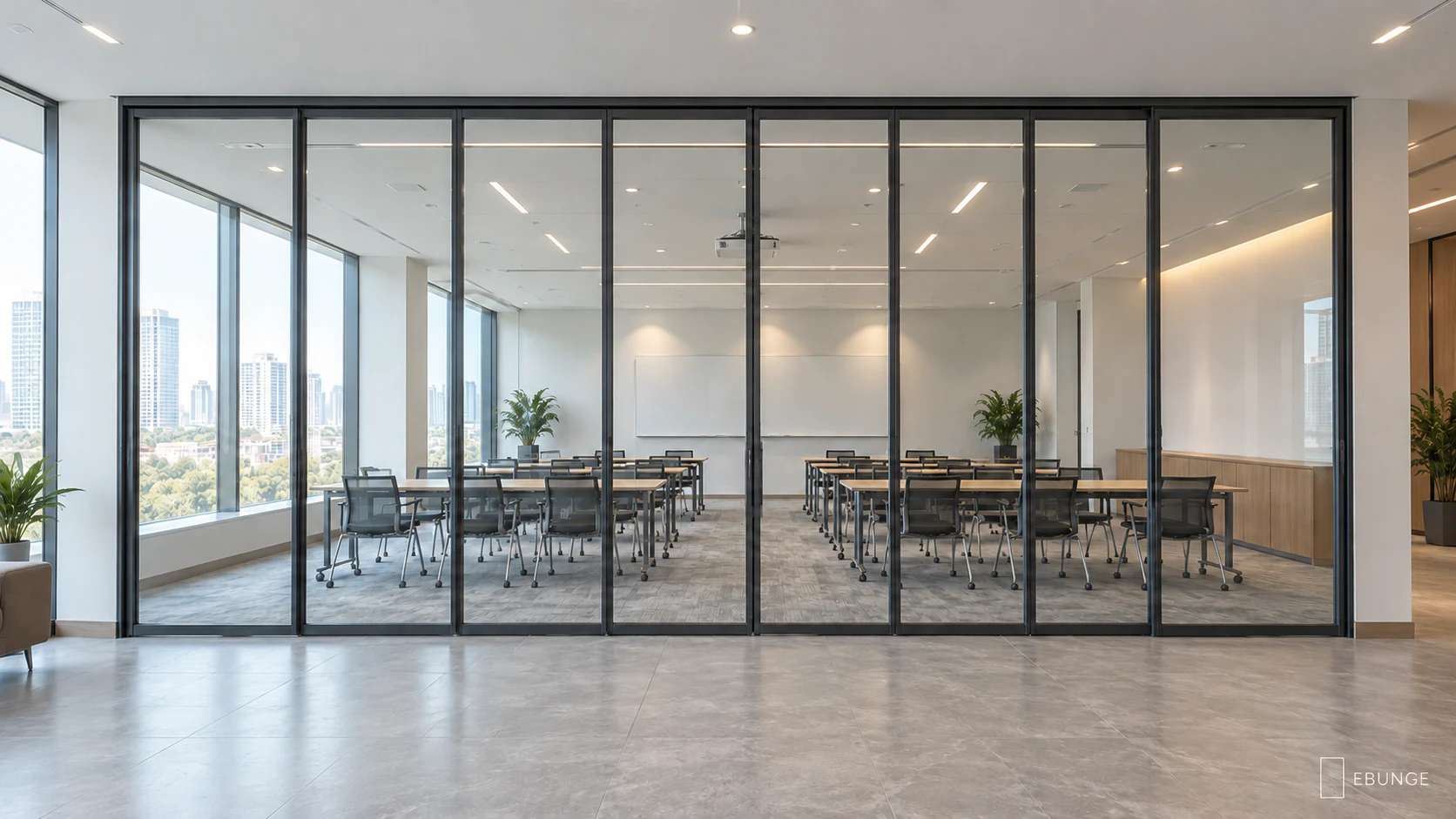
A useful policy is short enough to be followed under time pressure. It should be written for the people who actually move the panels, not only for the project file. The following sequence keeps the policy tied to maintained product facts and avoids assumptions about hidden performance.
- Confirm the target configuration from the booking record.
- Verify that the planned parking position is clear of furniture and stored items.
- Move panels individually along the reviewed overhead route.
- Check that the opening is fully clear or fully closed as required.
- Record any obstruction, route issue or damaged finish for follow-up.
- Reset the room for the next booking and confirm the schedule.
Step three depends on a continuous connected overhead route. The exact route, junction arrangement, continuous overhead path and parking position must be confirmed from the coordinated project drawings.
Where Scheduling Rules Change the Specification Conversation
Frequent changeovers put more emphasis on route clarity, parking discipline and finish durability than on a single headline performance figure. Finish options confirmed for EBUNGE include laminate, melamine, fabric, leather, glass and other approved surfaces. The right choice depends on the room’s use, cleaning regime and design intent, not on a generic claim.
A project team should confirm the required acoustic target, the tested configuration and the site conditions with the supplier and the acoustic consultant.
Coordination Between Facility Operations and Project Teams
Facility Operations & Space Management coordination is where the policy either works or fails. The operations team knows the booking reality; the project team knows the partition system. Both need to review the same layout drawings and the same route assumptions.
Evidence note
Visible finishes, photographs and drawings show appearance and intent. They do not prove acoustic performance, structural capacity, fire behaviour, durability or application reference results. Those items require separate project-specific evidence.
When the schedule changes after installation, the policy should be reviewed rather than quietly ignored. A new booking pattern may require a different parking position or a revised changeover window.
Common Policy Mistakes and How to Avoid Them
Another is assuming that any clear floor area can serve as a parking position without checking the reviewed stacking route. A third is treating a finish sample as evidence of cleaning compatibility or impact resistance.

| Policy area | Weak approach | Better approach |
|---|---|---|
| Changeover window | Assume staff will manage | Define a minimum gap from the schedule |
| Parking position | Use whatever space is free | Confirm the planned stacking position |
| Route | Assume a straight path | Review straight, turning and stacking routes |
| Finish | Choose from appearance alone | Confirm approved surface for the use case |
| Acoustics | Quote a single number | Confirm project-specific acoustic requirements |
Each row should be checked against the actual layout. Where information is missing, the policy should say so rather than fill the gap with an assumption.
Documentation and Handover
Project documentation can be discussed with EBUNGE, including pass-door requirements and the drawings needed for review. The changeover policy should be issued alongside the as-built layout, the approved finish schedule and the route review. That package gives the operations team a single reference point.
During handover, walk the route with the people who will use it. Confirm the parking position, the opening sequence and the reporting process for issues. If the room schedule later changes, revisit the policy before the change takes effect.
Frequently Asked Questions
What is a movable glass partition changeover policy?
It is a written operating rule that describes how a flexible room is reconfigured between bookings, including the sequence, the parking position and the route to be used.
Does the policy depend on the partition system?
Yes. EBUNGE panels are individually movable and top-hung, so the policy can focus on route and parking rather than floor hardware. The exact overhead route and support arrangement must be confirmed by the responsible project team from coordinated drawings.
Can the policy guarantee acoustic performance?
No.
How often should the policy be reviewed?
Review it whenever the booking pattern, room layout or furniture arrangement changes, and after any reported route or parking issue.
What information should be shared with the supplier?
Share the layout, the expected configurations, the booking frequency and any pass-door requirement. The project team can then discuss documentation and route review.
Are named venues a limitation?
No. Named venues are examples only. Movable partitions can be considered wherever flexible spatial division, combination or reconfiguration is required.
Conclusion and Next Step
Room scheduling rules shape a movable glass partition changeover policy because they define how often the room must change and how much time is available. A good policy is evidence-bounded: it uses confirmed product facts, states its limits and sends unresolved acoustic, support and dimensional questions to project-specific review.
To discuss your layout, finish options, pass-door requirements and project documentation, contact EBUNGE. You can also review the custom movable glass partition systems, browse the product range, explore space solutions, check application examples or visit the engineering resources before your next coordination meeting.