

Run a Tender Deviation Review for Movable Glass Partition Bids
Quick project answer
Review focus: movable glass partition.
A movable glass partition tender deviation review is the structured comparison of each bidder’s offer against the tender documents, drawing set and stated project requirements. It is not a negotiation tactic. It is a risk-control step that helps contractors, architects, owners and procurement teams see where a bidder has proposed something different from the brief, and whether that difference is documented, coordinated and acceptable. The review should stay close to maintained product facts and visible evidence, and it should send every unresolved performance, support or dimensional question back to project-specific confirmation.
Why a Deviation Review Matters Before Award
Project review term: movable glass partition.
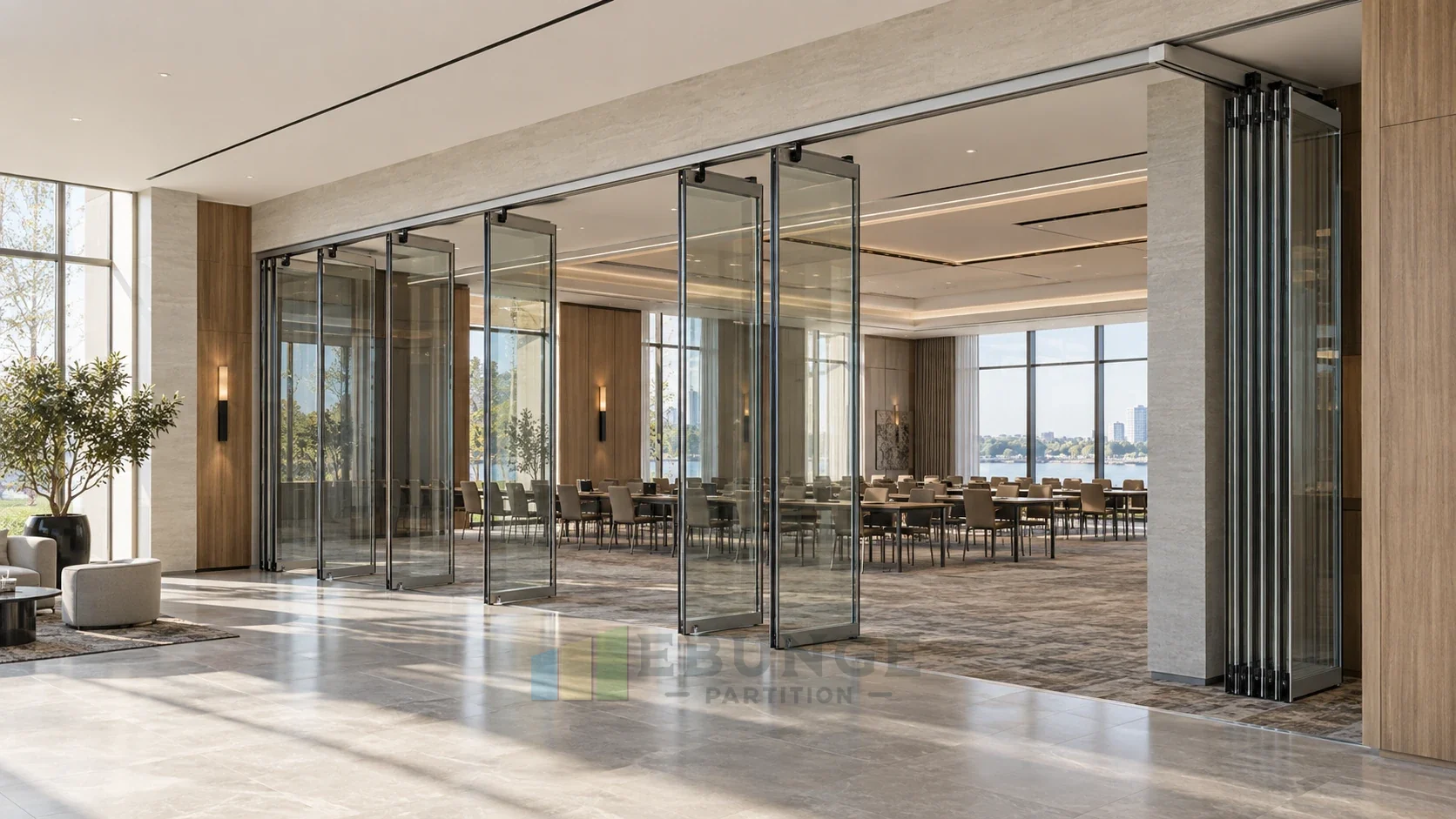
Movable glass partitions are configured systems. Panels are individually movable, suspended from a top track, cross the opening without a floor track, and park at a planned stacking position. Because the movement path, parking zone and support conditions are project-specific, a bid can look compliant on price while quietly changing the route, the finish schedule or the documentation package.
A deviation review separates harmless commercial adjustments from technical changes that affect coordination. It also creates a written record of what each bidder has actually offered, which reduces the chance of disputes later when drawings are developed.
Set the Review Scope and Evidence Rules First
Before opening any bid, agree what counts as evidence. Visible references can support layout discussion but do not verify hidden construction or performance.
Define what the review will and will not decide
The review can confirm that a bidder has addressed the required items, identified deviations and supplied the requested documentation. The suitability of each route and parking arrangement depends on the approved layout, circulation, ceiling interfaces and operating sequence.
Keep STC and Rw in context
Treat any acoustic figure in a bid as a claim that needs its own project-specific confirmation, not as a value the review can infer from a drawing or finish.
A Step-by-Step Deviation Review Process
- Log the tender baseline. Record the issued drawings, specification sections, finish schedule and any addenda so every bidder is compared against the same version.
- Build a deviation register. For each bidder, list every stated or implied difference from the baseline, including route changes, parking arrangements, finish substitutions and documentation gaps.
- Classify each deviation. Mark it as commercial, documentation, dimensional, route-related or performance-related.
- Check the movement route. Confirm that the proposed straight, turning and stacking routes are shown on the layout and that the overhead route is continuous and connected. The exact route, junction arrangement, continuous overhead path and parking position must be confirmed from the coordinated project drawings.
- Review the parking position. Confirm where panels will stack, whether that position is coordinated with adjacent trades, and whether the bidder has described how the parking style suits the layout.
- Compare finish schedules. Check laminate, melamine, fabric, leather, glass and other approved surfaces against the project schedule, and note any substitution that needs design approval.
- Confirm pass-door and access requirements. Where a pass door is required, confirm that the bidder has addressed it and that the documentation shows how it integrates with the panel layout.
- Issue clarification requests. Ask each bidder to close documentation gaps in writing before scoring, so the final comparison is based on complete offers.
Drawing and Documentation Checks That Expose Hidden Deviations
Most tender deviations appear in the drawings before they appear in the price. A bidder may show a simplified route, omit the parking zone or leave the support condition to others. The review should compare each drawing against the tender layout and note where information is missing rather than assuming it will be resolved later.
| Review item | What to look for | Action if unclear |
|---|---|---|
| Movement route | Straight, turning and stacking paths shown on plan | Request a marked-up layout from the bidder |
| Overhead continuity | Continuous connected top track along the full route | Ask for confirmation and project-specific support review |
| Parking position | Planned stacking location coordinated with the room | Confirm with the design team and adjacent trades |
| Finish schedule | Laminate, melamine, fabric, leather, glass or other approved surfaces | Refer substitutions to the designer for approval |
| Pass door | Requirement addressed in the bid documents | Request details if the bid is silent |

Finish, Acoustic and Support Questions to Route Back to the Project Team
Some questions cannot be settled at tender stage. The deviation review should identify these questions clearly rather than letting a bidder’s assumption become the baseline.
Finish and visual coordination
Finish options include laminate, melamine, fabric, leather, glass and other approved surfaces.
Acoustic and support confirmation
Acoustic seals and related details are project-specific. The review can note that a bidder has addressed acoustic intent, but it should not convert that into a guaranteed result.
Scoring Deviations Without Overstating Certainty
A useful scoring model separates compliance from risk. Score the completeness of the offer, the clarity of the route and parking proposal, and the quality of the documentation package.
Do not score inferred performance. If a bidder claims a result without project-specific evidence, record it as an open item.
FAQ: Movable Glass Partition Tender Deviation Review
What is a movable glass partition tender deviation review?
It is a structured comparison of each bid against the tender documents, drawings and requirements, identifying where a bidder has proposed something different and whether that difference is documented and acceptable.
Which deviations should be treated as technical rather than commercial?
Changes to the movement route, parking position, overhead continuity, support assumptions, finish schedule or pass-door provision are technical. They affect coordination and should be reviewed by the design and engineering team, not only by procurement.
Can the review confirm acoustic performance from a bid?
No.
How should finish substitutions be handled?
Laminate, melamine, fabric, leather, glass and other approved surfaces should be compared against the project schedule. Any substitution should be referred to the designer for approval and should not be used to infer other performance.
What if a bidder shows a route that crosses an untracked gap?
That is a deviation requiring clarification. Every proposed movement path needs a continuous connected overhead route and project-specific support review.
When should the project team confirm support and dimensional requirements?
Before award, the team should identify every open support, acoustic and dimensional question and route it to the appropriate reviewer. Final confirmation belongs to the project-specific design and engineering process.
Conclusion and Next Step
A disciplined movable glass partition tender deviation review protects the project by making differences visible early. Keep the review tied to maintained product facts, visible evidence limits and drawing-based coordination. Where a bid raises support, acoustic or dimensional questions, send them back for project-specific confirmation instead of assuming a result.
To discuss pass-door requirements, project documentation or a layout review for your next tender, contact EBUNGE. You can also review the custom movable glass partition systems, browse the product range, explore project solutions, check application examples or use the engineering resources before issuing your next clarification round.