

Score Movable Glass Partition Bids Without Lowest-Price Bias
Quick answer: movable glass partition bid
Review focus: movable glass partition bid.
Movable glass partition bid scoring should compare what each bidder actually includes, not just the bottom-line number. A low bid can leave route reviews, finish coordination or documentation outside the price. A high bid can include items your project does not need. The goal is a repeatable scorecard tied to your drawings, your operating assumptions and the evidence each supplier provides. This guide sets out an evidence-bounded framework for procurement and tender review teams.
Start With the Project Brief, Not the Price Column
Project review term: movable glass partition bid.
Before opening any bid, confirm the brief your team issued. The brief should state the room or venue type, the opening dimensions, the parking position, the finish direction and any pass-door requirement. The exact route, junction arrangement, continuous overhead path and parking position must be confirmed from the coordinated project drawings. These are the same route types reviewed from the layout during coordination.
If the brief is vague, bidders will fill the gaps differently. One may price a simple straight run. Comparing those two numbers directly is misleading. Score the brief first, then score the bids against it.
Build a Weighted Scorecard Before Bids Arrive
Coordination scope: movable glass partition bid.
A weighted scorecard keeps the evaluation consistent. Decide the categories and their relative importance before you see any pricing. The categories below are a starting point; adjust them to your project stage and risk profile.
| Category | What to Review | Evidence to Request |
|---|---|---|
| Scope alignment | Does the bid match the issued brief and layout? | Marked-up drawing, scope statement |
| Route and parking review | Are straight, turning and stacking routes addressed? | Route sketch, parking position note |
| Finish coordination | Are laminate, melamine, fabric, leather, glass or other approved surfaces identified? | Finish schedule, sample references |
| Documentation | Are submittals, coordination notes and pass-door details included? | Document list, responsibility matrix |
| Commercial clarity | Are inclusions, exclusions and assumptions stated? | Written clarification list |
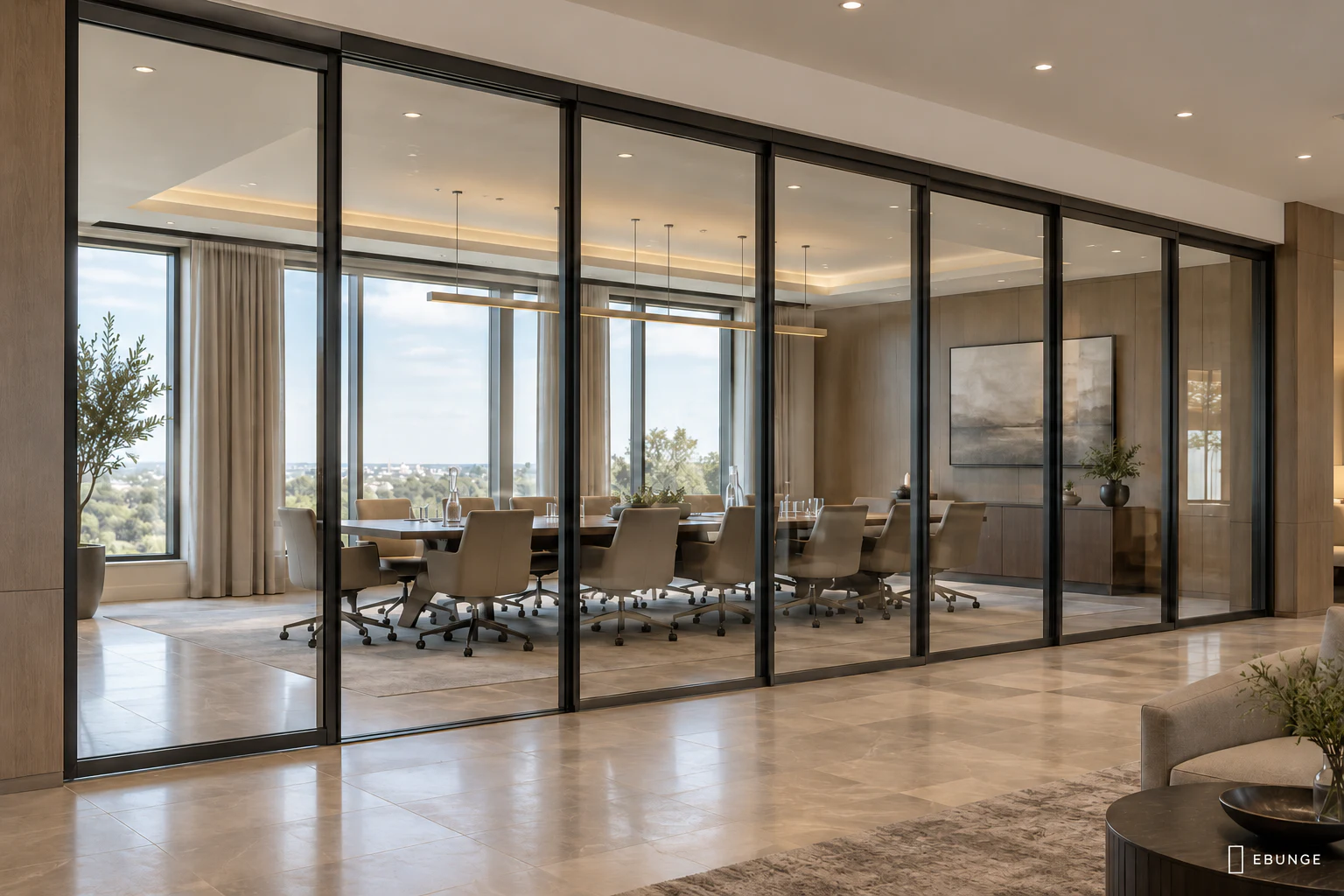
Weight each category according to project priority. A hotel ballroom with a complex parking zone may weight route review heavily. An office renovation with a simple straight run may weight finish coordination and documentation more heavily.
Score Movement Routes and Parking Realistically
Checklist focus: movable glass partition bid.
Movable glass partition panels are individually movable and suspended from a top track. They cross the opening without a floor track and park at a planned stacking position. That means the overhead route must be continuous and connected.
Questions to put to every bidder
- Which route types does your bid assume: straight, turning, stacking, or a combination?
- Where does the parking position sit relative to the opening and adjacent rooms?
- Does the layout show a continuous connected overhead route for every proposed movement path?
- Are pass-door requirements included, and how are they documented?
Do not accept a verbal assurance that the route will work. Ask for a marked-up layout. If a bidder cannot show the route on your drawing, treat that as an open item rather than a resolved one.
Compare Finishes and Visible Evidence Carefully
Review focus: movable glass partition bid.
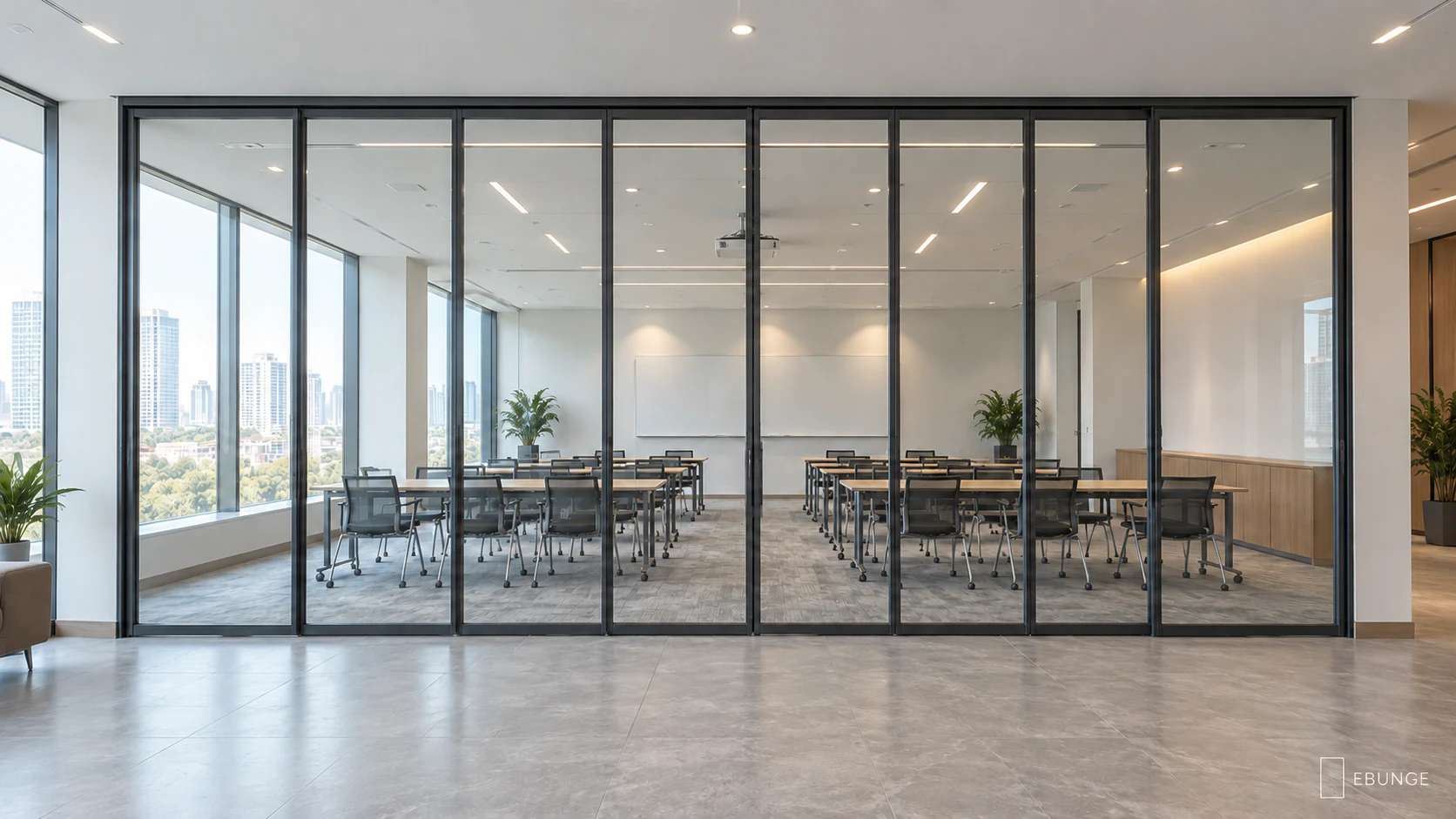
Confirmed finish options include laminate, melamine, fabric, leather, glass and other approved surfaces. A bid should state which finish is included and how it will be coordinated. A photograph or sample image shows appearance only. The suitability of each route and parking arrangement depends on the approved layout, circulation, ceiling interfaces and operating sequence.
Project-specific acoustic requirements need their own review and confirmation.
Evidence note: visible finish samples, drawings and photographs support appearance and coordination discussions. They do not establish hidden performance, engineering outcomes or commercial results. Confirm project-specific support, acoustic and dimensional requirements in writing.
Use a Numbered Review Process for Consistency
- Issue a complete brief with layout, route types, parking position, finish direction and pass-door requirements.
- Require each bidder to return a marked-up drawing and a written scope statement.
- Score scope alignment, route review, finish coordination, documentation and commercial clarity against the weighted scorecard.
- List every assumption, exclusion and open item in a clarification log.
- Hold a coordination call to resolve route, finish and documentation questions before final scoring.
- Re-score only after written clarifications are received, then compare adjusted totals.
This process does not remove judgment, but it makes the basis of each score visible. It also reduces the chance that a low headline price wins simply because it excludes work your project needs.
Documentation and Pass-Door Requirements
Pass-door requirements and project documentation can be discussed with the supplier during tender review. Ask each bidder to state what documentation they will provide, who is responsible for coordination and when submittals will be issued. A bid that leaves documentation undefined creates risk later.
For complex layouts, request a responsibility matrix. It should show which party confirms dimensions, which party reviews the overhead route and which party coordinates finishes. This is not about adding paperwork for its own sake. It is about making the bid comparable.
Common Scoring Mistakes to Avoid
Lowest-price bias often appears in small decisions. A team may award points for a low number without checking what the number covers. Another common mistake is treating a generic finish or application example as evidence of performance. A third is assuming that a route will work because the opening looks straightforward on a floor plan.
Keep the evaluation tied to maintained product facts and visible evidence limits. Where a claim cannot be supported, mark it as requiring project-specific confirmation. That keeps the scorecard honest and protects the project from hidden assumptions.
Frequently Asked Questions
What is movable glass partition bid scoring?
It is a structured method for comparing supplier bids against a project brief, using weighted categories such as scope alignment, route review, finish coordination and documentation. It is not a simple price ranking.
Why is lowest-price bias a problem in tender review?
A low bid may exclude route reviews, finish coordination or documentation that your project requires. Without a scorecard, those gaps are easy to miss until after award.
What layout information should be included in the brief?
Include the opening dimensions, parking position, straight, turning and stacking routes, finish direction and any pass-door requirements. Confirm project-specific support, acoustic and dimensional requirements with the supplier.
Can a bidder confirm acoustic performance from a drawing?
No. Drawings and finish samples support appearance and coordination discussions.
How should pass-door requirements be scored?
Score them as part of scope alignment and documentation. Ask each bidder to state whether pass doors are included and how they will be documented. If the answer is unclear, log it as an open item.
When should the scorecard be finalized?
Finalize categories and weights before bids arrive. After clarifications, re-score only the items that changed.
For the next planning step, compare application solutions, review the related EBUNGE guide, review the related EBUNGE guide and confirm the opening, ceiling condition, layout, finish direction and acoustic requirement for the project.
Conclusion and Next Step
Compare scope, routes, finishes and documentation. Mark unsupported claims as open items. Confirm project-specific support, acoustic and dimensional requirements in writing before award.
To discuss your layout, route review or documentation needs, contact EBUNGE. You can also review custom movable glass partition systems and browse products for coordination context.