

What a Tender Review Should Verify in a Framed Movable Glass Wall Bid
Quick answer: framed movable glass wall
Framed movable glass wall tender verification is the discipline of checking what a bid actually commits to before award. A framed movable glass wall is not a single product; it is a configured system of individually movable panels suspended from a top track, crossing the opening without a floor track and parking at a planned stacking position. The tender review must confirm that the bidder has priced and documented the routes, interfaces and evidence that the project requires. This guide sets out a practical framework for overseas contractors, architects, interior designers, owners and procurement teams.
Start With the Movement Routes, Not the Finish
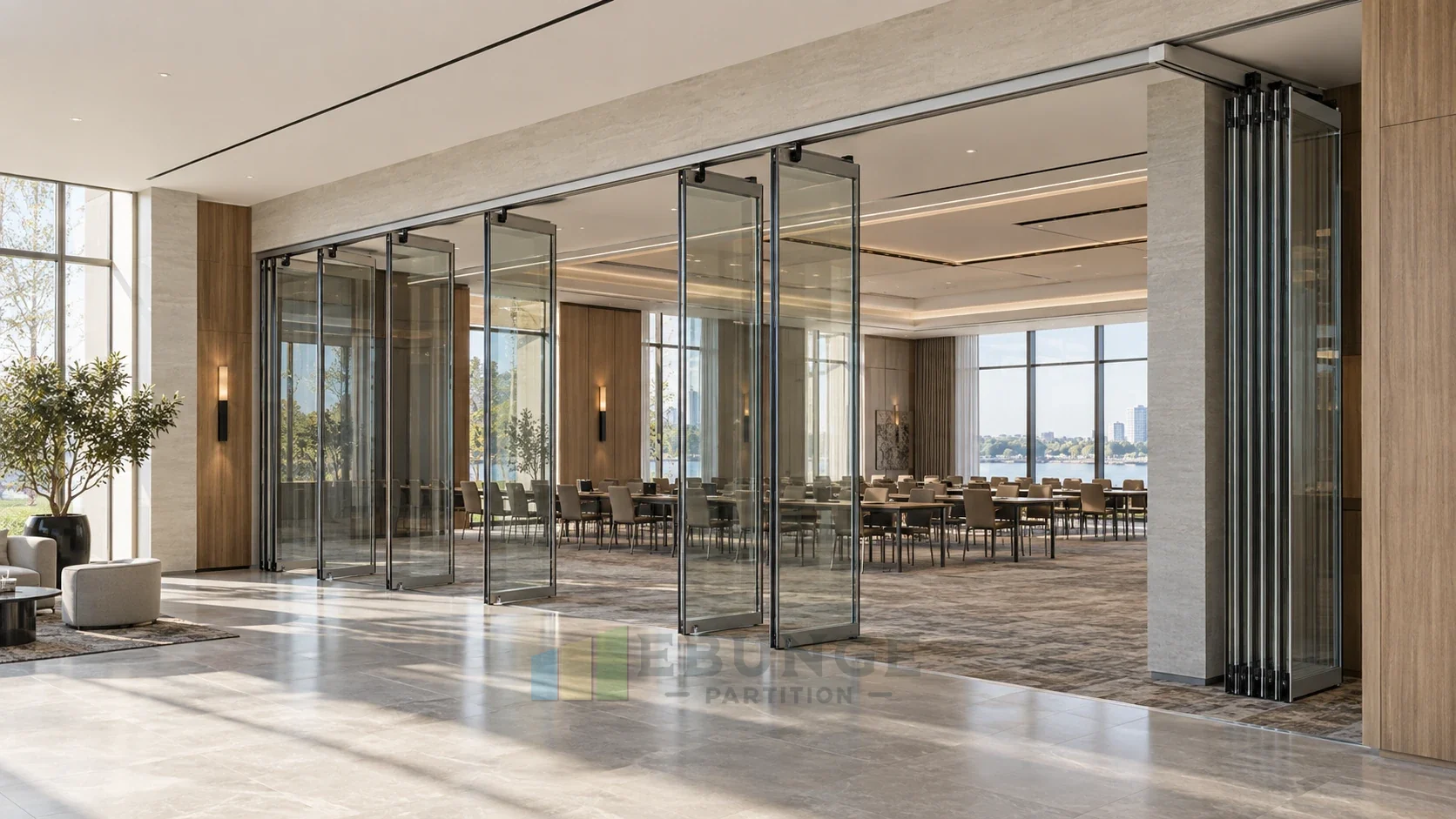
Every framed movable glass wall depends on a continuous connected overhead route. Straight, turning and stacking routes should be reviewed from the layout drawing, not inferred from a photograph or a generic brochure. The suitability of each route and parking arrangement depends on the approved layout, circulation, ceiling interfaces and operating sequence.
The exact route, junction arrangement, continuous overhead path and parking position must be confirmed from the coordinated project drawings. The maintained product facts confirm that panels are top-hung and move without a continuous floor running track or floor hardware along the partition line.
Route questions for the bidder
- Does the bid include a route drawing for straight, turning and stacking movements?
- Where does the overhead route connect to the building structure, and who confirms support?
- Is the parking position shown on the layout, including any recess or return?
- Are pass-door requirements identified in the opening sequence?
Verify the Stacking and Parking Strategy
Parking style is customized to the customer layout and project requirements and may support compact stacking when the coordinated design permits it. The tender review should confirm that the stacking position is planned, not left to site improvisation. A bid that shows panels but not where they park is incomplete.
Ask the bidder to describe how the stacked panels relate to adjacent walls, columns, services and finishes. If the stacking area is shared with other trades, the tender should identify the coordination responsibility. This is a drawing review point, not a performance claim.
Evidence note
Visible drawings and finish samples show configuration and appearance. They do not prove acoustic performance, structural capacity, fire behaviour, durability or application reference outcomes. Those require separate project-specific confirmation.
Check Finish and Material Statements Carefully
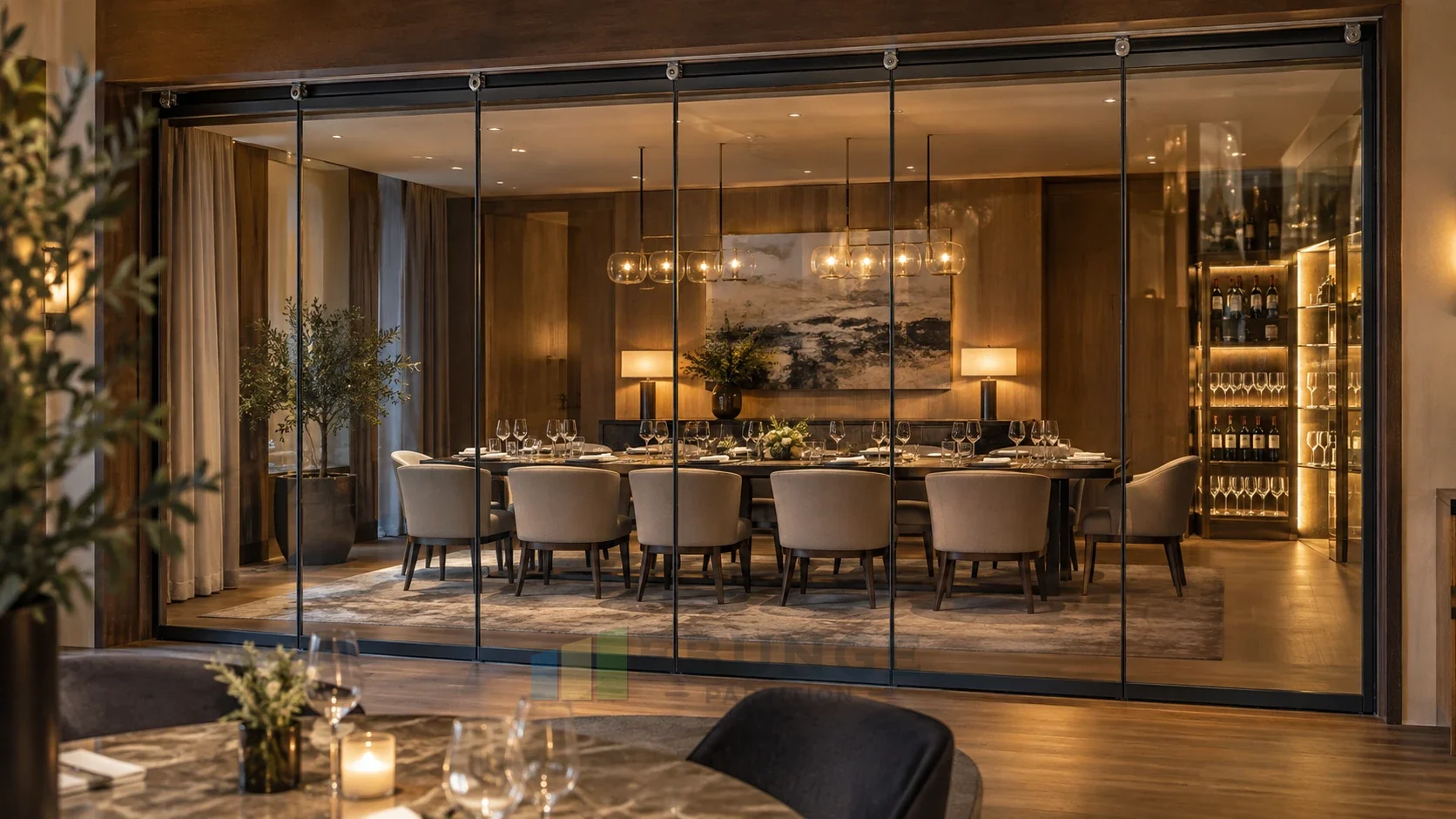
Confirmed finish options include laminate, melamine, fabric, leather, glass and other approved surfaces. The tender should state which finish is proposed for each panel face and edge, and whether the sample submitted matches the specification reference. A generic finish name is not evidence of cleaning compatibility, impact resistance or acoustic behaviour.
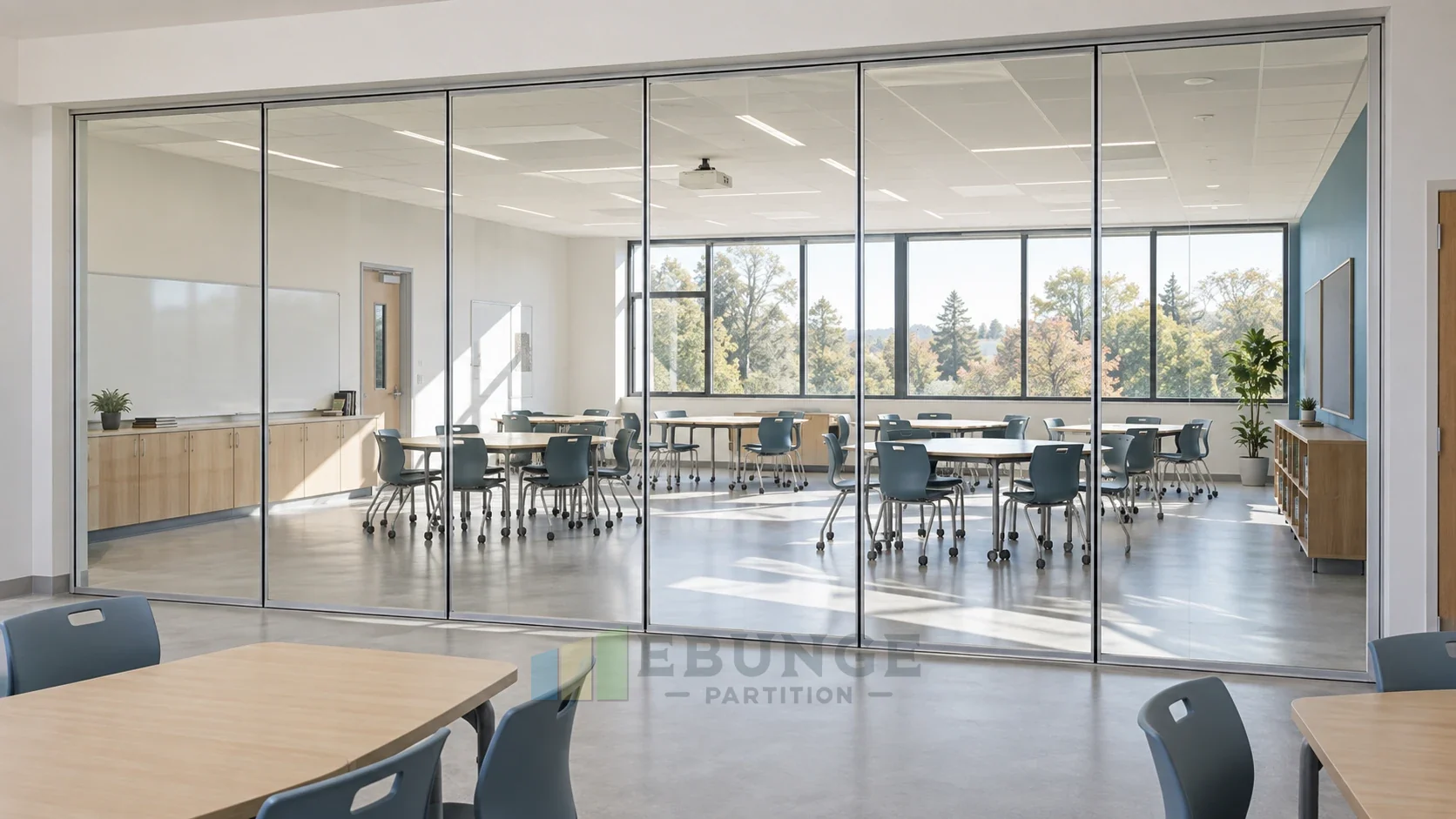
Where glass is specified, the bid should clarify the visible configuration and how it interfaces with the frame. Visible references can support layout discussion but do not verify hidden construction or performance. If the project requires a specific acoustic or fire outcome, that must be confirmed separately with the responsible specialist.
Finish review checklist
- Finish reference and sample submitted for each visible surface.
- Edge and frame finish coordination with adjacent materials.
- Glass type and visible configuration described without inferred performance.
- Cleaning and maintenance instructions requested as project documentation, not assumed.
Understand What Acoustic Terms Do and Do Not Mean
A framed movable glass wall tender should state the acoustic requirement, the test standard referenced, and the boundary conditions under which any rating is claimed.
Seals and acoustic concepts can be explained generically, but the tender review should not accept a single number as proof of in-situ performance. Project-specific acoustic requirements must be confirmed with the responsible acoustic consultant and the system supplier.
Review Pass Doors, Interfaces and Documentation
Pass-door requirements and project documentation can be discussed with the supplier. The tender should identify whether a pass door is included, how it operates within the panel sequence, and what documentation will be provided for approval, installation and handover.
A bid that omits interface responsibility often creates site delays. The review should confirm who supplies, who installs and who signs off each interface.
Documentation to request
- Layout and route drawings marked with stacking and parking positions.
- Finish schedule and sample references.
- Interface and support coordination notes.
- Installation and handover documentation scope.
- Confirmation of project-specific acoustic, dimensional and support requirements.
Use a Tender Review Matrix to Compare Bids
A compact matrix helps the team compare submissions without inventing performance conclusions. Score each bid on evidence completeness, not on marketing language.
| Review area | What to verify | Evidence boundary |
|---|---|---|
| Movement route | Straight, turning and stacking paths shown | Requires layout review and support confirmation |
| Parking | Stacking position and coordination | Customized to project layout |
| Finish | Sample and schedule match | Appearance only; no hidden performance |
| Acoustic | Requirement and standard stated | Project-specific confirmation required |
| Documentation | Drawings, interfaces, handover scope | Confirm scope with supplier |
Use the matrix in a pre-award meeting. Where a bid is silent, record it as an open item rather than assuming the missing information will be resolved later.
Coordinate Procurement and Tender Review Across Disciplines
Each discipline confirms a different boundary: support, dimensions, acoustic requirement and installation sequence. The tender review should record who confirms what and by when.
For product-family context, review the framed movable glass partition page and the wider products overview. Application examples are non-exhaustive; named venues do not limit other suitable flexible-space uses. Teams can also review solutions and applications for planning language, and use engineering resources to structure drawing requests.
Frequently Asked Questions
What is the first thing to verify in a framed movable glass wall tender?
Verify the movement routes. Confirm that straight, turning and stacking paths are shown on the layout and that the overhead route is continuous and supported. Finish and acoustic statements come after the route is understood.
Can a framed movable glass wall work without a floor track?
Yes. EBUNGE movable partition panels are top-hung and move without a continuous floor running track or floor hardware along the partition line. The overhead route still requires project-specific support review.
Does a finish sample prove acoustic performance?
No. A finish sample shows appearance and surface reference only.
How should STC or Rw be treated in a tender?
The tender should state the requirement, the referenced standard and the conditions under which any rating is claimed. Confirm with the responsible acoustic specialist.
What documentation should accompany the bid?
Request layout and route drawings, stacking positions, finish schedule, interface coordination notes and handover documentation scope. Pass-door requirements and project documentation can be discussed with the supplier.
Are named venues a limitation on where the system can be used?
No. Named venues are examples only. Movable partitions can be considered wherever flexible spatial division, combination or reconfiguration is required, subject to project-specific review.
Conclusion and Next Step
A framed movable glass wall tender review succeeds when it separates visible evidence from project-specific confirmation. Check routes, stacking, finishes, acoustic boundaries and documentation. Do not accept unsupported performance, engineering or commercial conclusions. Where information is missing, record it as an open item and confirm it before award.
To discuss pass-door requirements, project documentation or a tender review checklist for your layout, contact EBUNGE with your drawings and requirements.