

Detect Scope Gaps in a Movable Glass Partition Tender
Quick project answer
Movable glass partition tender scope gap detection is the discipline of comparing what a tender package asks for against what the drawings, specification and site conditions actually describe. The suitability of each route and parking arrangement depends on the approved layout, circulation, ceiling interfaces and operating sequence. It can be an unclear movement route, an undefined parking condition, an unstated interface, or a performance expectation that no document supports. For overseas project teams, the goal is not to guess the missing answer but to expose the question early enough for the design team to resolve it.
Start With the Movement Route, Not the Panel
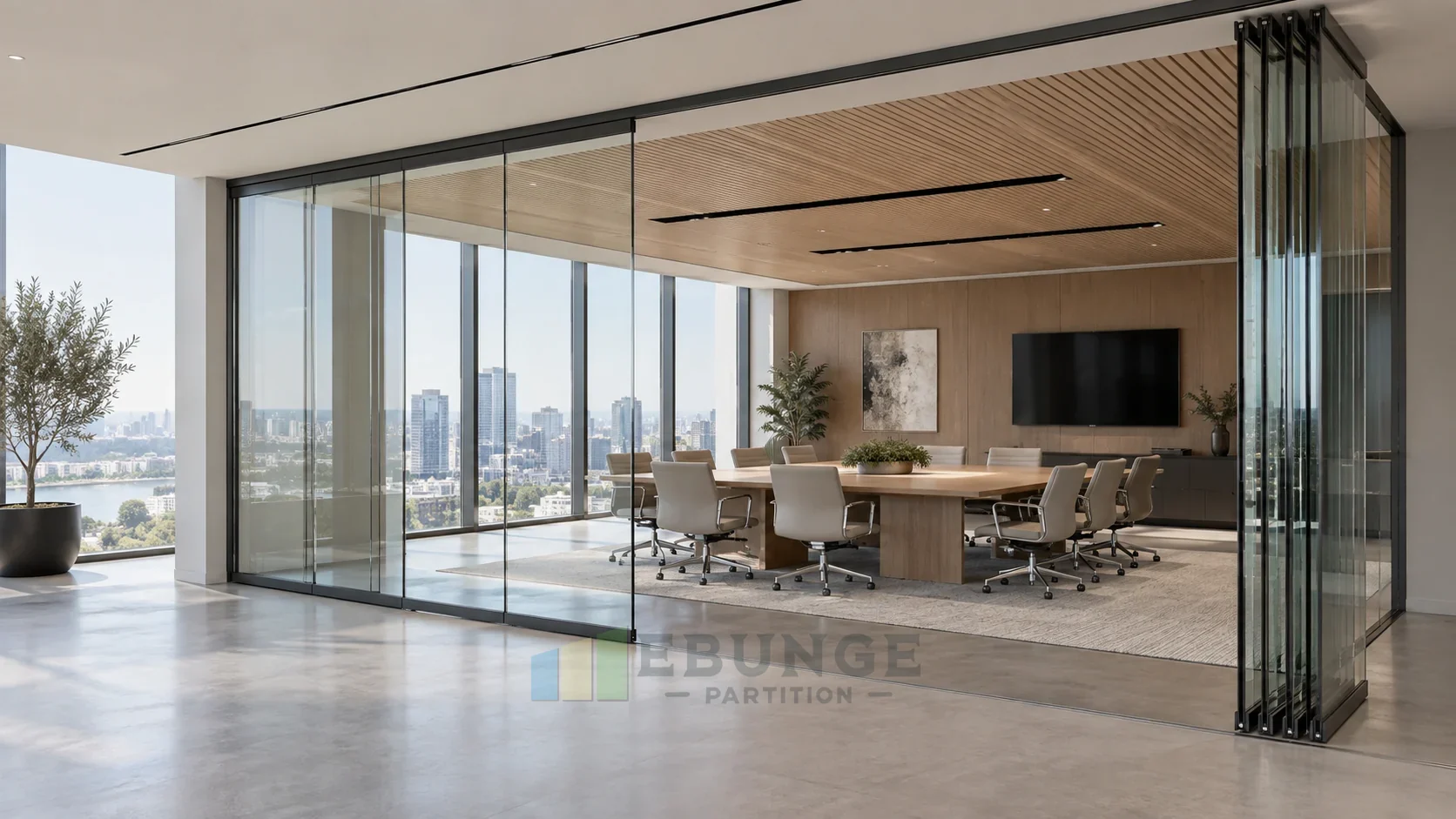
Movable glass partitions are top-hung and travel without a continuous floor track along the partition line. That single fact changes how a tender should be read. The review must follow the panel from its closed position, across the opening, and into its planned stacking position.
Ask whether the tender shows a continuous connected overhead route for every proposed movement. The exact route, junction arrangement, continuous overhead path and parking position must be confirmed from the coordinated project drawings. The route may be straight, turning or stacking, and each segment needs to be visible in the layout before pricing can be meaningful.
Evidence note
Visible geometry in a drawing does not prove acoustic, structural or operational performance. Treat every performance statement as unconfirmed until the project-specific documentation supports it.
Build a Scope Gap Checklist Before You Price
A tender review becomes repeatable when the same questions are asked in the same order. The checklist below is deliberately about scope, not about product claims. It helps a contractor or buyer identify what is missing rather than assume what is included.
- Opening and closed positions: Are both states dimensioned, including the relationship to adjacent walls, columns and finishes?
- Movement route: Is the full path shown as a continuous connected overhead route, including turns and the final parking location?
- Parking condition: Is the stacking position defined, and does the layout show how panels gather there without conflicting with other trades?
- Pass-door requirement: Is a pass door needed, and is its location and swing described in the tender documents?
- Finish schedule: Are laminate, melamine, fabric, leather, glass or other approved surfaces identified by location?
- Interface boundaries: Who supplies and coordinates the supporting structure, adjacent partitions, ceilings and finishes?
- Documentation set: Are drawings, schedules and approval routes listed, or only implied?
Separate Visible Evidence From Performance Expectations
Glass partitions are often specified with acoustic intent. If the specification names an acoustic target, the tender should also state how that target will be demonstrated and by whom.

A gap exists when the document asks for an outcome without defining the evidence that will confirm it.
Compact comparison: what a tender says vs. what the reviewer needs
| Tender statement | Reviewer question | Possible scope gap |
|---|---|---|
| Acoustic partition required | Which rating concept, which evidence route? | No defined confirmation method |
| Panels park at side | Is the stacking position drawn and dimensioned? | Parking condition undefined |
| Glass finish | Which approved surface, where? | Finish schedule incomplete |
| Top-hung system | Is the overhead route continuous and supported? | Support and route not coordinated |
Review the Drawing Set for Coordination Gaps
Scope gaps often appear at the edges of a package. The movable partition tender may be complete in itself while the surrounding coordination is missing. Look for the boundaries between the partition scope and the work of other trades.
Check whether the tender identifies who confirms the supporting structure, who sets the finished floor level, and who resolves clashes with ceiling services. If those responsibilities are absent, the gap is commercial as well as technical, because no single party can price the interface confidently.
Numbered process for a drawing review
- Trace the full movement route from closed position to parking position.
- Mark every point where the route depends on another trade or an unstated support condition.
- Compare the finish schedule against the room-by-room layout.
- List every performance statement and note whether its evidence route is defined.
- Record open questions as clarifications, not assumptions.
- Confirm project-specific support, acoustic and dimensional requirements with the design team before award.
Use Clarifications to Close Gaps Without Inventing Answers
A clarification is not a request for the supplier to design the project. It is a request to confirm what the tender already intends. Well-formed clarifications ask for missing information in a way that can be answered from project documents.
For example, instead of asking whether a system is acoustic, ask which rating concept applies and what documentation will demonstrate it. Instead of asking whether parking is possible, ask whether the drawn stacking position has been coordinated with adjacent finishes and services.
Evidence note (review 2)
Do not derive hidden acoustic, structural, durability or commercial performance from a visible shape, finish or photograph. If the tender does not define the evidence, the gap remains open.
Common Scope Gaps in Movable Glass Partition Tenders
Certain gaps recur across projects because they sit between disciplines. Recognising them early reduces the risk of a mid-project variation.
- Movement route shown only in the closed position.
- Parking position described in words but not drawn.
- Pass-door requirement mentioned but not scheduled.
- Finish options listed without room-by-room allocation.
- Acoustic intent stated without a confirmation route.
- Supporting structure and ceiling interfaces left unassigned.
- Project documentation and approval steps not listed.
Each of these is a question for the project team, not a conclusion about the product. The appropriate response is to request confirmation against the specific layout and specification.
Frequently Asked Questions
What is a scope gap in a movable glass partition tender?
A scope gap is missing or unclear information that prevents the tender from being priced or coordinated confidently. It may concern the movement route, parking position, finishes, interfaces or performance evidence.
Can a movable glass partition cross a gap in the floor?
No. The panels are top-hung and require a continuous connected overhead route.
How should acoustic requirements be reviewed in a tender?
The tender should define the project-specific acoustic requirement and the documentation route that will confirm it.
What finish information should the tender include?
The tender should identify approved surfaces such as laminate, melamine, fabric, leather, glass or other approved options, and allocate them by location where the layout requires it.
When should pass-door requirements be raised?
Pass-door requirements should be raised during tender review so the location, swing and coordination with the partition layout can be confirmed before fabrication planning.
Who confirms support and dimensional requirements?
A tender review should identify who that is.
Conclusion and Next Step
Detecting scope gaps in a movable glass partition tender is a structured comparison between the documents and the project conditions. Follow the movement route, check the parking position, verify finishes and interfaces, and separate visible evidence from performance expectations. Where information is missing, raise a clarification rather than filling the gap with an assumption.
To review your project documentation and discuss pass-door requirements, finish options or coordination questions, contact EBUNGE. You can also explore custom movable glass partition systems, review the product range, or see how these systems fit into broader project solutions and applications. For drawing-stage coordination, the engineering resources section is a useful starting point.