

Room Scheduling Data That Should Drive Changeover Policy
Quick project answer
Review focus: movable glass partition changeover policy data.
Room scheduling data is often treated as a booking problem, yet it quietly defines how a flexible room is expected to behave. For project teams, movable glass partition changeover policy data is the bridge between the calendar and the physical system: how often a room must change, which routes panels follow, and where they park. This article offers an evidence-bounded framework for using scheduling data to shape policy without inventing performance, cost or engineering conclusions.
Why Scheduling Data Belongs in the Changeover Conversation
Project review term: movable glass partition changeover policy data.
A movable partition is not a static wall. EBUNGE movable wall panels are individually movable, suspended from a top track, cross the opening without a floor track, and park at a planned stacking position. That means every changeover has a physical sequence: panels leave the closed position, travel along a continuous connected overhead route, and arrive at a coordinated parking location.
Scheduling data reveals how often that sequence is expected to happen, at what times, and under what room-use pressure. The suitability of each route and parking arrangement depends on the approved layout, circulation, ceiling interfaces and operating sequence. Those require separate project-specific confirmation. The value of scheduling data is that it exposes mismatches early, while drawings and requirements can still be coordinated.
Which Scheduling Signals Should Shape Policy
Coordination scope: movable glass partition changeover policy data.
Not every booking metric matters equally. The most useful signals describe change frequency, timing pressure and route conflict. Collect them from the room calendar, facility notes and user feedback, then review them alongside the layout drawing.
- Change frequency: how often the room moves between open and divided states on a typical day or week.
- Turnaround window: the time available between one booking ending and the next beginning.
- Peak overlap: periods when two adjacent rooms or events compete for the same opening or route.
- Parking demand: where panels are expected to rest when the room is open, and whether that position conflicts with circulation.
- User group: whether staff, students, guests or contractors are expected to operate the system.
These signals are planning inputs, not performance evidence.
From Data to Policy: A Numbered Coordination Process
Checklist focus: movable glass partition changeover policy data.
A changeover policy becomes useful when it is written down and tested against the layout. The following process keeps the discussion grounded in confirmed product facts and project-specific review.
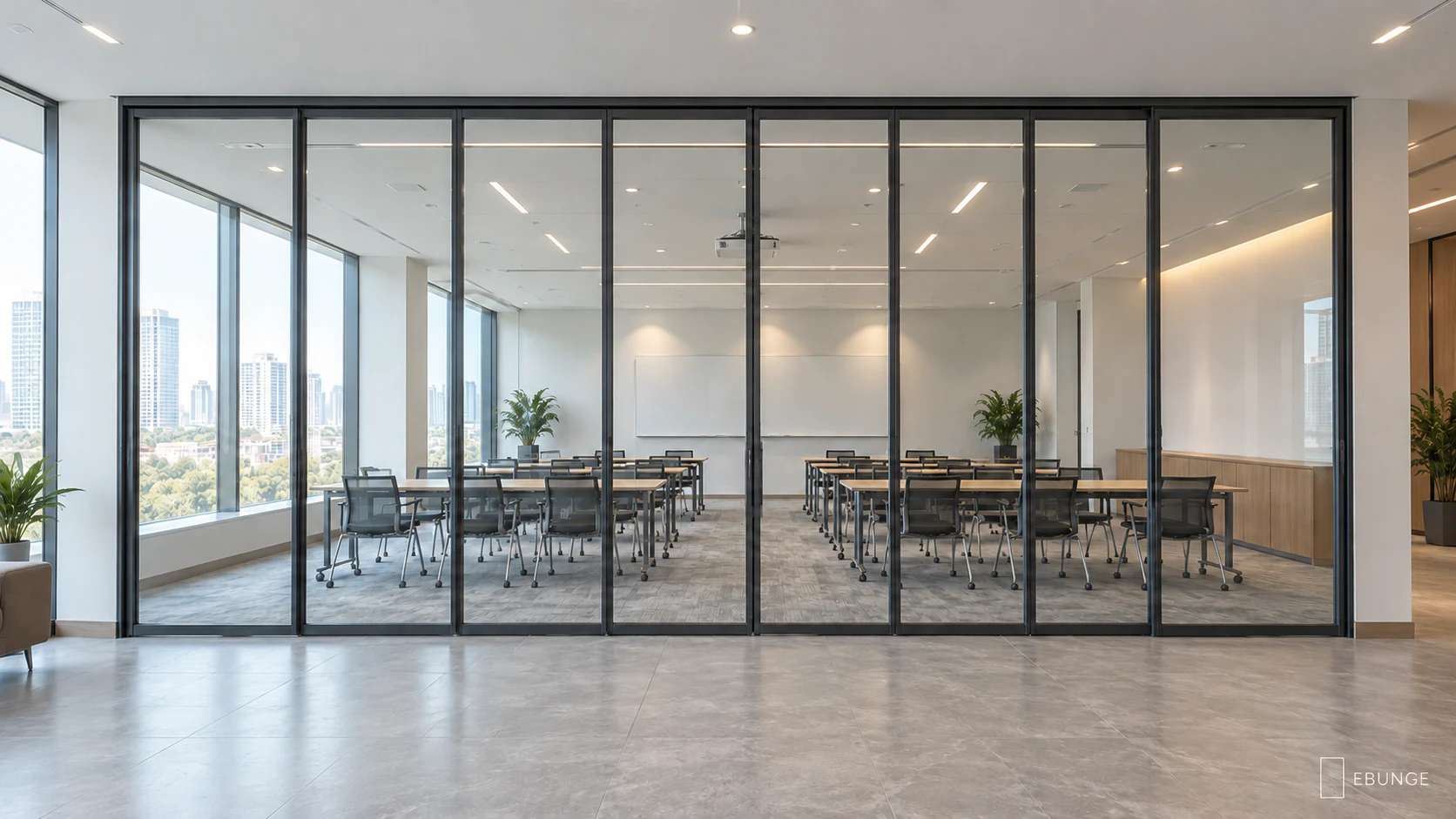
- Export the schedule. Gather booking data for a representative period, noting open, divided and combined room states.
- Map change moments. Identify when panels must move and whether those moments cluster around peak hours.
- Trace the route. Review straight, turning and stacking routes from the layout, confirming a continuous connected overhead route for every proposed movement path.
- Confirm parking. Check that the planned stacking position suits the room layout and does not block required circulation.
- Review pass-door needs. Discuss pass-door requirements and project documentation with the supplier where access through a closed partition matters.
- Record open items. List every assumption that still needs project-specific support, acoustic or dimensional confirmation.
- Publish and review. Issue the policy to operators and revisit it when scheduling patterns change.
Evidence Boundaries for Changeover Policy Data
Review focus: movable glass partition changeover policy data.
Changeover policy sits close to engineering, so it is easy to overstate what scheduling data proves. The exact route, junction arrangement, continuous overhead path and parking position must be confirmed from the coordinated project drawings.
Evidence note: Treat scheduling data as a planning input only. Confirm support, acoustic and dimensional requirements for the specific project before finalizing any policy statement. Do not derive hidden performance from a visible finish, photograph or drawing.
Coordinating Finishes, Routes and Documentation
Project review term: movable glass partition changeover policy data.
Changeover policy also touches visible specification choices. Confirmed finish options include laminate, melamine, fabric, leather, glass and other approved surfaces.
Route coordination deserves equal attention. Straight, turning and stacking routes are reviewed from the layout, and parking style is customized to the customer layout and project requirements. Where the coordinated design permits it, compact stacking may be considered. The project team should confirm that the proposed route, parking position and support conditions are documented before installation planning proceeds.
Decision Checklist for Project Teams
Use this checklist during design review and handover discussions. It is deliberately limited to items that can be confirmed from maintained product facts and project drawings.

| Decision area | Question to confirm | Evidence needed |
|---|---|---|
| Change frequency | How often will the room change state? | Scheduling data and user brief |
| Route | Is there a continuous connected overhead route? | Layout drawing review |
| Parking | Where will panels rest when open? | Coordinated stacking position |
| Pass door | Is access through the closed partition required? | Project documentation discussion |
| Finish | Which approved surface suits the space? | Confirmed finish options |
| Acoustic | What separation is required? | Project-specific acoustic confirmation |
Common Pitfalls When Writing Changeover Policy
One frequent pitfall is treating a high change frequency as proof that a system is suitable. Frequency describes demand, not capability. Another is assuming that a parking position shown on an early sketch is final; parking is customized and must be coordinated with the layout.

Such promises are outside the confirmed evidence boundary. Instead, state the operational expectation, identify the confirmation route, and record who will verify support, acoustic and dimensional requirements.
FAQ: Movable Glass Partition Changeover Policy Data
What scheduling data is most useful for changeover policy?
Change frequency, turnaround windows, peak overlap, parking demand and user group are the most practical signals. They describe how the room is used, not how the partition performs.
Does scheduling data confirm acoustic performance?
No. Scheduling data is a planning input.
Can panels move across an untracked gap?
No. Every proposed movement path requires a continuous connected overhead route and project-specific support review. Straight, turning and stacking routes are reviewed from the layout.
How should parking be decided?
Parking style is customized to the customer layout and project requirements. The planned stacking position should be coordinated with circulation and documented before installation planning.
Which finishes can be considered?
Confirmed finish options include laminate, melamine, fabric, leather, glass and other approved surfaces.
When should pass-door requirements be discussed?
Pass-door requirements and project documentation can be discussed with the supplier during design coordination, especially where access through a closed partition matters.
Conclusion: Let Data Ask Better Questions
Room scheduling data should not be used to promise outcomes. A changeover policy built on those questions is more useful than one built on assumptions.
For project teams evaluating custom movable glass partition systems, review the product overview, explore solutions and applications, and use the engineering resources to prepare drawing review. When the layout, schedule and requirements are ready, contact EBUNGE to discuss pass-door requirements, project documentation and project-specific confirmation.