

Run a Tender Risk Review for a Framed Movable Glass Wall
Quick project answer
Review focus: framed movable glass wall.
A framed movable glass wall tender risk review is a structured check of what the drawings, specification and bid documents actually say before a contract is awarded. It is not a performance test and it does not replace project-specific engineering. The suitability of each route and parking arrangement depends on the approved layout, circulation, ceiling interfaces and operating sequence.
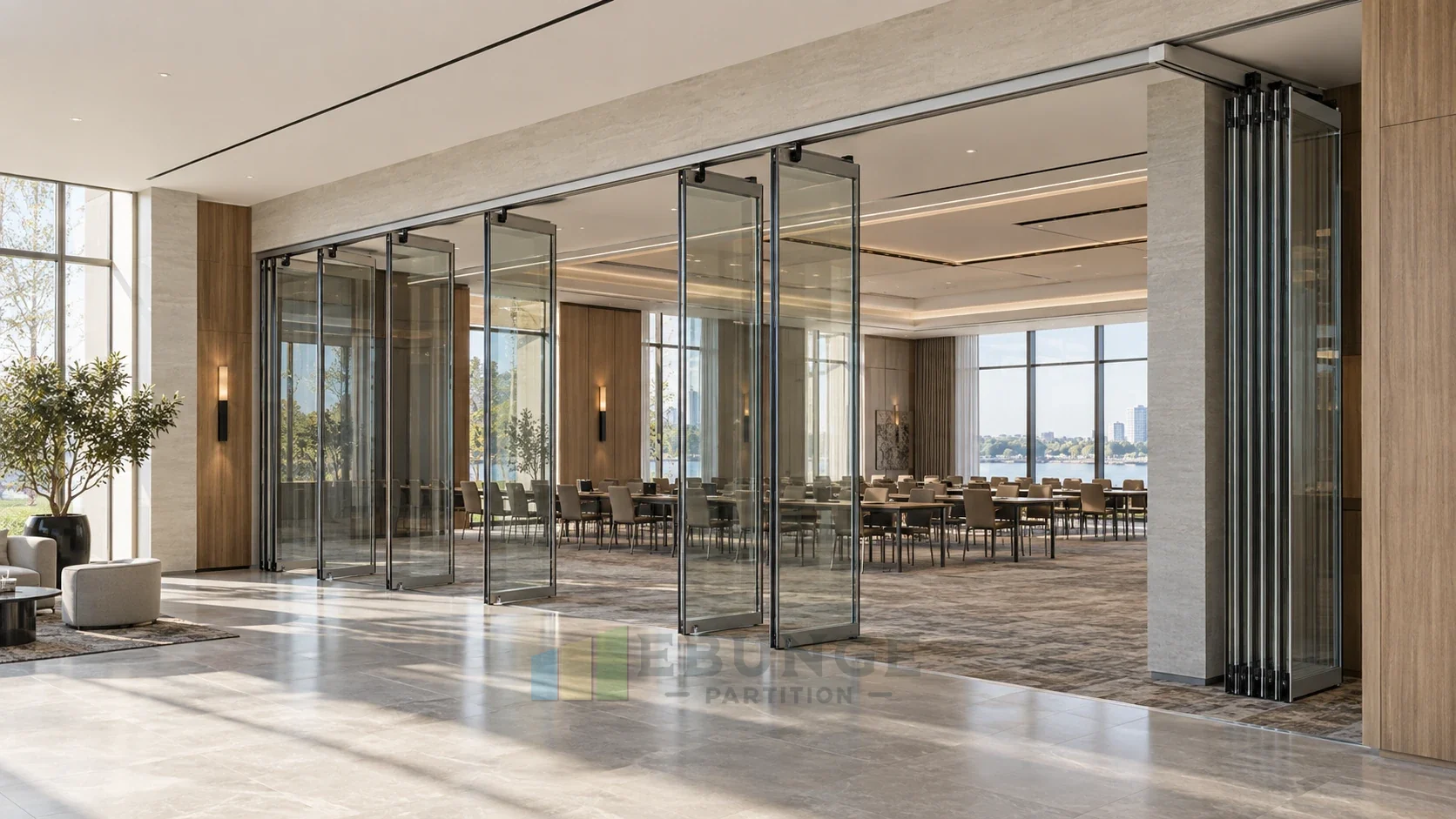
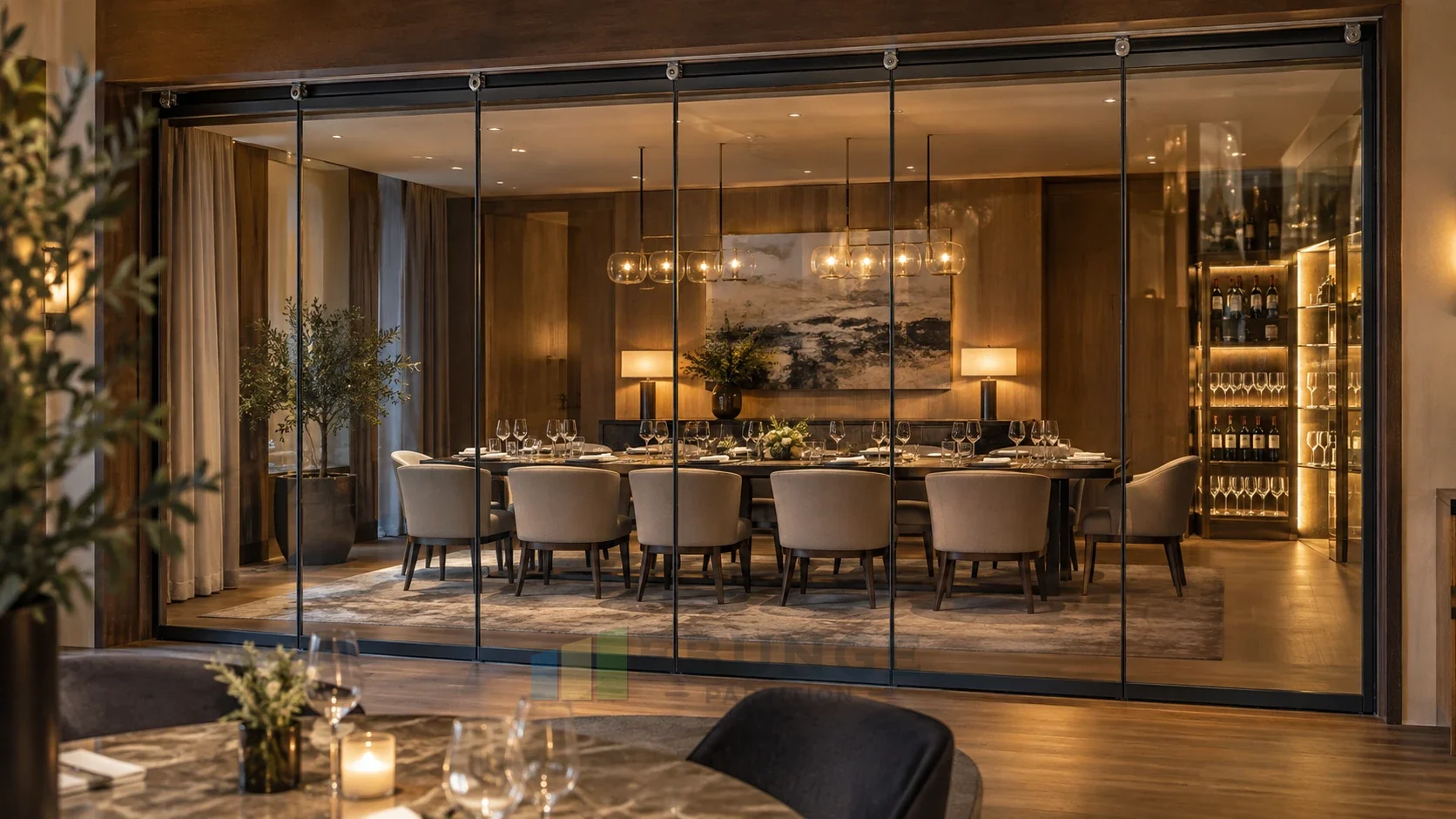
EBUNGE movable partition panels are individually movable, suspended from a top track, cross the opening without a floor track, and park at a planned stacking position. Straight, turning and stacking routes are reviewed from the layout. Confirmed finish options include laminate, melamine, fabric, leather, glass and other approved surfaces. Pass-door requirements and project documentation can be discussed. Everything else must be confirmed for the specific project.
Why a Tender Risk Review Matters for Framed Movable Glass Walls
Project review term: framed movable glass wall.
A framed movable glass wall sits at the intersection of architecture, structure, procurement and operations. The tender stage is where assumptions are cheapest to correct. If the documents are silent on a route, a support condition or a finish interface, bidders may price different scopes, and the comparison becomes unreliable.
The review should separate three categories: confirmed product facts, project-specific requirements that still need evidence, and commercial or performance claims that must not be inferred. Visible references can support layout discussion but do not verify hidden construction or performance. Treat every unnamed value as an open item.
What the review is not
It does not certify that a proposed layout will work. It does not convert a generic product description into a project guarantee. Its output is a clearer question list and a more comparable tender package.
Start With the Layout and Movement Routes
Coordination scope: framed movable glass wall.
The layout is the first evidence source. The exact route, junction arrangement, continuous overhead path and parking position must be confirmed from the coordinated project drawings. Confirm that the proposed movement path has a continuous connected overhead route. If the design shows a gap, mark it as a coordination item for project-specific support review.
Check the parking zone against adjacent doors, services, finishes and circulation. A compact stacking arrangement may be possible when the coordinated design permits it, but parking style is customized to the customer layout and project requirements. The tender should state who confirms the final parking geometry and when.
Questions to put to the design team
- Does the drawing show a continuous overhead route for every proposed movement path?
- Is the stacking position dimensioned and coordinated with adjacent trades?
- Are pass-door locations shown, and are their requirements described?
- Are interface points between the partition and surrounding construction clearly assigned?

Build a Tender Risk Checklist
Use a checklist that forces each risk to a named owner and a required document. The table below is a starting structure, not a substitute for project-specific confirmation.
| Review area | Evidence to request | Risk if missing |
|---|---|---|
| Movement route | Layout showing straight, turning and stacking paths | Bidders price different scope |
| Overhead support | Project-specific support review by the responsible engineer | Unresolved structural coordination |
| Finish selection | Approved finish schedule and sample references | Ambiguous visual and interface expectations |
| Acoustic intent | Project acoustic requirement stated as a design target | Misunderstanding of STC or Rw concepts |
| Documentation | Drawing register, revision status and approval route | Work proceeds on superseded information |
Coordinate Procurement and Tender Review Across Disciplines
Architects and interior designers confirm design intent and finish direction. Contractors confirm site interfaces and sequence. Owners confirm operational expectations. Distributors confirm the inquiry route and documentation package.
Assign one person to maintain the open-items log. Each item should record the question, the responsible party, the required evidence and the date it was closed. This prevents the same uncertainty from reappearing after award.
Evidence note
Do not derive hidden acoustic, fire, durability, load, maintenance, certification or commercial performance from a visible shape, finish, photograph or drawing. Comparative, absolute and causal statements require corresponding evidence; otherwise remove them or state the exact project-specific confirmation boundary.
Review the Specification Language
A framed movable glass wall tender risk review specification should describe the required outcome without inventing values. Where a performance target is needed, state it as a project requirement and identify who will confirm compliance. Where a finish is selected, reference the approved finish schedule. Where a pass-door is required, describe its role in the layout and ask for project documentation.
These are not supported by the confirmed facts and should be replaced with bounded language. Panel handling and the operating sequence must be confirmed for the selected layout and project conditions.
Numbered process for closing open items
- Collect the latest drawings, specification and finish schedule.
- Mark every route, support, interface and performance statement that lacks evidence.
- Convert each mark into a written question with a named owner.
- Request project-specific confirmation from the responsible discipline.
- Update the tender comparison only when the evidence is received.
- Record residual risks in the award recommendation.
Common Tender Risk Review Mistakes
One common mistake is treating a product family page as a project specification. Another is comparing bids on headline price while the scopes differ. A third is leaving the stacking position to be resolved after award, when it affects adjacent trades and circulation.
Neither is supported. Keep the review anchored to maintained product facts, visible evidence limits and project-specific drawing review.
Frequently Asked Questions
What information is required for a framed movable glass wall tender risk review?
At minimum, the latest layout showing straight, turning and stacking routes; the finish schedule; the drawing register; and a clear statement of any project-specific acoustic, support or dimensional requirements. Pass-door requirements and project documentation can be discussed with the supplier.
Can the tender documents specify acoustic performance?
They can state a project acoustic requirement as a design target. Confirm project-specific acoustic requirements with the responsible specialist.
Do framed movable glass walls need a floor track?
EBUNGE movable partition panels are top-hung and move without a continuous floor running track or floor hardware along the partition line. Every proposed movement path still requires a continuous connected overhead route and project-specific support review.
How should parking and stacking be reviewed?
Parking style is customized to the customer layout and project requirements and may support compact stacking when the coordinated design permits it. The tender should identify who confirms the final stacking geometry and how it interfaces with adjacent trades.
Which finish options can be reviewed at tender stage?
Confirmed finish options include laminate, melamine, fabric, leather, glass and other approved surfaces.
What should happen if the drawings show a gap in the movement route?
Mark it as an open item. Request a revised layout or a project-specific support review before comparing bids.
Conclusion and Next Step
It produces a clearer, more comparable package by separating confirmed facts from open questions. Review the layout, the routes, the finishes and the documentation; assign owners; and close items with evidence.
To discuss pass-door requirements, project documentation or a specific layout, contact EBUNGE. You can also review the framed movable glass partition page, browse products, explore solutions, check applications, or use the engineering resources for drawing review. Confirm project-specific support, acoustic and dimensional requirements before award.