

Bid Review Checklist for Movable Glass Partition Projects
Quick project answer
Review focus: movable glass partition.
A movable glass partition tender pricing audit is not a line-by-line price comparison. It is a structured review of whether the tender documents describe the same scope, the same movement routes and the same finish expectations. When those three layers are misaligned, pricing gaps appear later as variations, exclusions or unresolved coordination items. This guide gives procurement teams a repeatable audit method without inventing performance, engineering or commercial conclusions.
Why Pricing Gaps Appear in Movable Glass Partition Tenders
Project review term: movable glass partition.
Most gaps are not arithmetic errors. They come from scope boundaries that were never written down. The exact route, junction arrangement, continuous overhead path and parking position must be confirmed from the coordinated project drawings. One may include a parking position; another may treat it as a site item. The tender may name a finish family without confirming the approved surface.
Because EBUNGE movable wall panels are individually movable, suspended from a top track, cross the opening without a floor track and park at a planned stacking position, the audit must follow the panel path, not just the panel count. Straight, turning and stacking routes are reviewed from the layout. If the layout is missing or schematic, the pricing basis is incomplete.
Start With the Drawing Set, Not the Price Schedule
Coordination scope: movable glass partition.
Before comparing numbers, confirm that every bidder received the same drawing set. The audit team should identify the opening, the intended movement path and the planned parking zone on the same plan. A tender that references a route but does not show it cannot be audited fairly.
Drawing items that change pricing scope
- Opening width and height as drawn, with any dimensional confirmation still open.
- Straight, turning and stacking routes shown as a continuous connected overhead route.
- Parking position and whether the coordinated design permits compact stacking.
- Pass-door requirements, if any, and where they occur in the run.
- Finish areas and approved surface references.
- Interface points with adjacent construction, ceilings and structure.
Where a drawing is silent, mark it as an open item rather than assuming a default. The exact overhead route and support arrangement must be confirmed by the responsible project team from coordinated drawings.
Build a Scope Alignment Checklist
A pricing gap often hides inside a scope word such as supply, install, coordinate or allow. The checklist below helps the audit team separate what is described from what is merely implied.

| Tender item | What to verify | Evidence boundary |
|---|---|---|
| Panel movement | Individually movable, top-hung, no floor track along the partition line | Confirm against maintained product facts and the project layout |
| Routes | Straight, turning and stacking routes reviewed from the layout | Do not infer travel across an untracked gap |
| Parking | Planned stacking position and coordination with adjacent works | Customized to layout and project requirements |
| Finishes | Laminate, melamine, fabric, leather, glass or other approved surfaces | Finish choice does not prove acoustic or structural performance |
| Pass doors | Requirement and location discussed with the supplier | Confirm project-specific details in writing |
| Documentation | Project documentation discussed and listed | Do not assume certification or test values |
Use this table as a working document. Any row that cannot be answered from the tender package becomes a clarification question, not a silent assumption.
Audit the Acoustic Language Without Inventing Numbers
The suitability of each route and parking arrangement depends on the approved layout, circulation, ceiling interfaces and operating sequence. The audit should check whether the tender states a project-specific acoustic requirement and whether the supplier has been asked to confirm it.
Seals and acoustic concepts can be explained generically, but the tender should not be treated as proof of performance. If the documents claim a rating without a project-specific basis, flag it for confirmation.
Separate Confirmed Facts From Assumptions

An evidence-bounded audit distinguishes three categories: confirmed product facts, project-specific confirmations and open assumptions. Confirmed facts include the top-hung movement principle, the absence of a continuous floor running track along the partition line, and the available finish families. Project-specific confirmations include support, acoustic and dimensional requirements. Open assumptions are everything else.
If a tender line depends on an assumption that is not written in the documents, it is a pricing gap waiting to be claimed as a variation.
Record each assumption with an owner and a required confirmation date.
Run a Numbered Clarification Process
- Issue the same drawing set and scope checklist to every bidder.
- Ask each bidder to mark the movement route and parking position on the plan.
- Request written confirmation of finish surfaces and pass-door requirements.
- Ask how project-specific support, acoustic and dimensional requirements will be confirmed.
- Compare responses against the scope alignment table, not against each other’s prices alone.
- Convert every unresolved item into a clarification question before award.
This process does not require the audit team to design the system. It requires them to make the tender comparable. For product context, see the custom movable glass partition systems page and the broader product overview.
Common Pricing Gap Patterns to Flag
Certain patterns recur across tenders. A bidder may price panels but exclude route coordination. Another may include a finish family without confirming the approved surface. A third may treat parking as a site condition rather than a coordinated design item.
Flag any tender that describes movement without showing a continuous connected overhead route. These are scope gaps, not price differences.
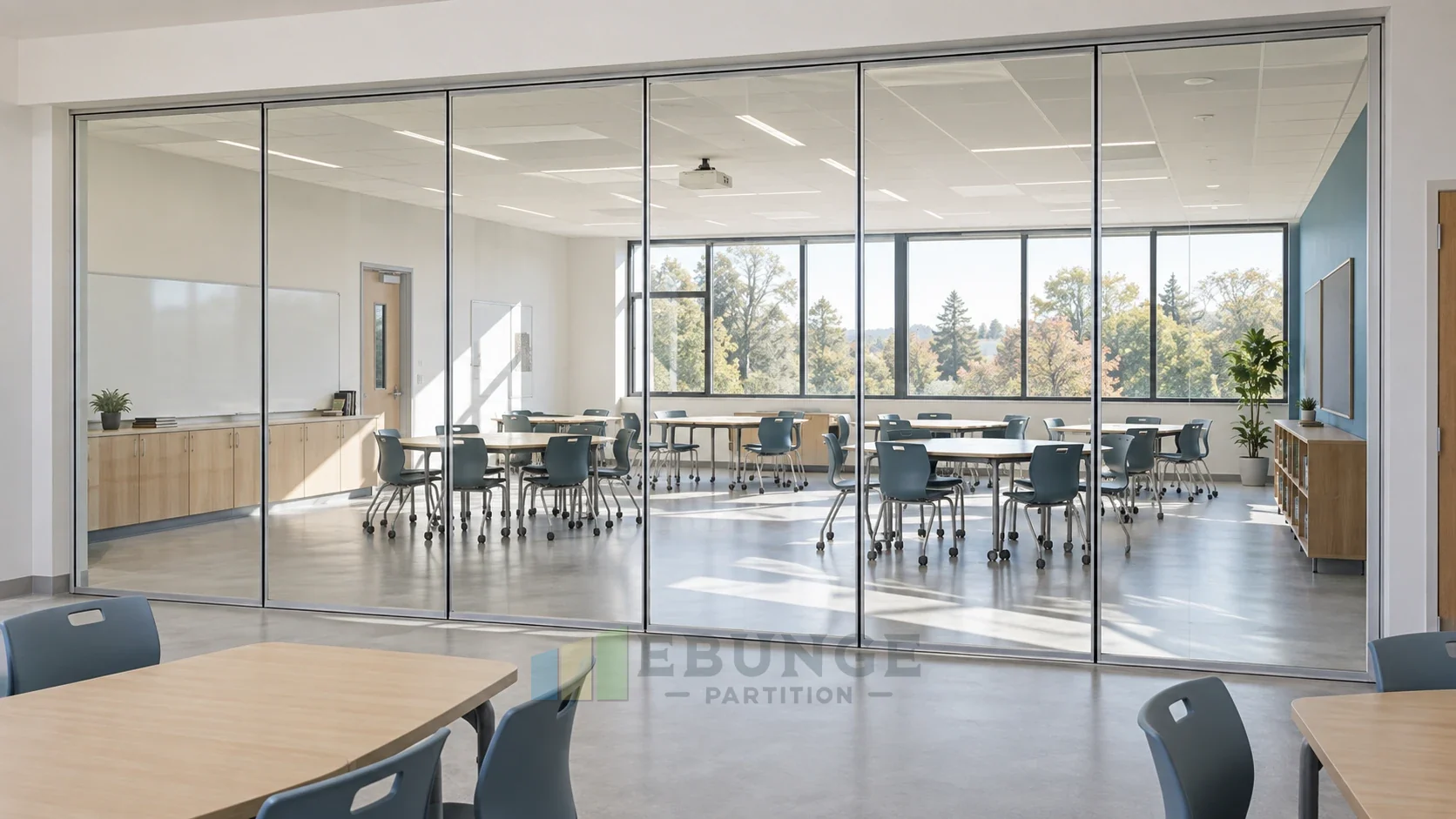
Application examples such as meeting rooms, dining areas or conference foyers are illustrative only. Movable partitions can be considered wherever flexible spatial division, combination or reconfiguration is required. The named venue does not limit other suitable applications, and it does not prove a application reference.
Document the Audit Trail for Award
The final audit output should be a short, traceable record: the drawing revision reviewed, the scope items confirmed, the items still open and the clarification questions issued. This record protects the project from later disputes about what was included.
Use the engineering resources and solutions sections to align terminology, and review applications for context. The goal is not to rank bidders on price alone but to confirm that each price rests on the same described scope.
Frequently Asked Questions
What is a movable glass partition tender pricing audit?
It is a structured review of whether tender documents describe the same scope, movement routes, finishes and coordination items, so that pricing gaps can be identified before award rather than after.
Do I need a floor track for movable glass partitions?
EBUNGE movable wall panels are suspended from a top track and cross the opening without a floor track.
Can the tender specify an acoustic rating?
Visible references can support layout discussion but do not verify hidden construction or performance.
Which finishes can be priced in the tender?
Confirmed finish options include laminate, melamine, fabric, leather, glass and other approved surfaces.
How should parking and stacking be audited?
Parking style is customized to the customer layout and project requirements and may support compact stacking when the coordinated design permits it. The planned stacking position should be shown on the layout and reviewed with the route.
What if the tender shows a turning route?
Straight, turning and stacking routes are reviewed from the layout.
Conclusion and Next Step
A movable glass partition tender pricing audit succeeds when it compares described scope, not assumed scope. Confirm the drawing set, align the movement routes, verify finishes and pass-door requirements, and convert every open item into a written clarification.
To discuss pass-door requirements, project documentation or a layout review for your tender, contact EBUNGE with your drawings and scope questions.