

Run a Tender Query Log for Movable Glass Partition Packages
Quick project answer
A movable glass partition tender query log is a controlled register of every clarification, assumption, and evidence request that arises between tender issue and award. For overseas contractors, architects, interior designers, owners, and renovation teams, the log protects the project from silent assumptions about movement routes, finishes, and acoustic intent. It also creates a clear audit trail when drawings, specifications, and supplier responses must be reconciled. This guide explains how to structure, run, and close a query log for movable glass partition packages using only confirmed product facts and project-specific confirmations.
Why a Tender Query Log Matters for Movable Glass Partition Packages
Movable glass partitions are not a single product. They are a coordinated system of panels, top track, parking arrangement, and finish selections. The suitability of each route and parking arrangement depends on the approved layout, circulation, ceiling interfaces and operating sequence. Without a query log, unanswered items can be absorbed into a bid as assumptions. Those assumptions may later conflict with the actual layout or with the confirmed product configuration.
The log is not a substitute for design review. It is a record of what has been asked, what has been answered, and what still requires project-specific confirmation. It keeps procurement, design, and site teams aligned without implying performance that has not been verified.
Setting Up the Log Before Tender Issue
Start the log as soon as the tender package is drafted. Assign a single owner, usually a procurement lead or project engineer, and a review cycle. Every entry should have a unique query number, date raised, originator, subject, related drawing or specification reference, status, and response. The log should be shared with the design team and the supplier coordination contact.
Core fields to include
- Query ID and revision number
- Date raised and date response required
- Discipline or package area
- Drawing or specification reference
- Query description and reason
- Response and supporting evidence
- Status: open, answered, closed, or superseded
- Impact on cost, programme, or design
Keep the log in a format that can be exported and attached to the tender addendum.
What to Ask About Movement, Parking, and Layout
Confirmed EBUNGE facts state that movable wall panels are individually movable, suspended from a top track, cross the opening without a floor track, and park at a planned stacking position. Straight, turning, and stacking routes are reviewed from the layout. These facts should shape the questions you raise.
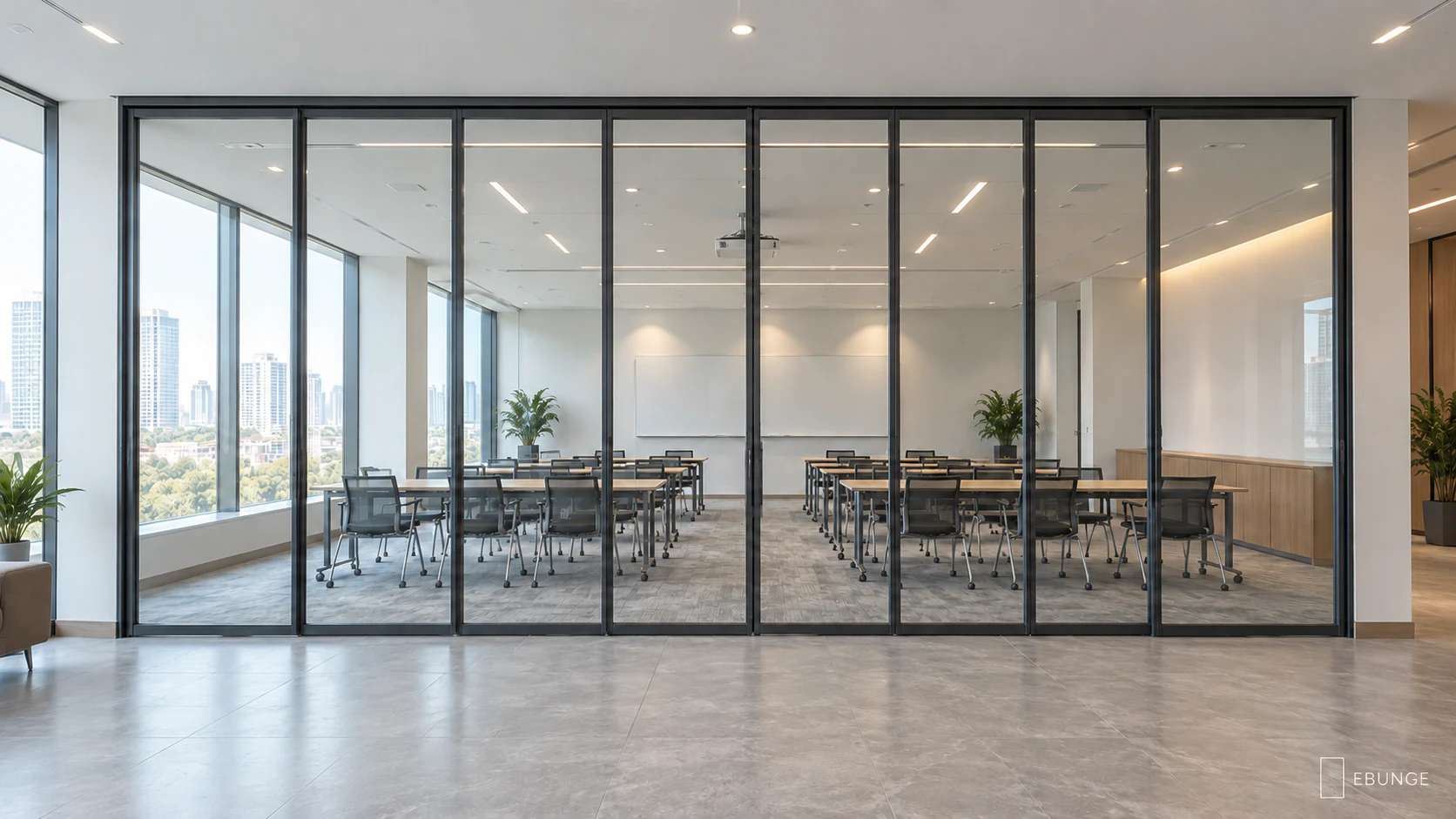
Ask whether the proposed opening can be crossed by a continuous connected overhead route. Ask where panels will park and whether the stacking position has been coordinated with adjacent finishes, services, or structure. The exact route, junction arrangement, continuous overhead path and parking position must be confirmed from the coordinated project drawings. Every proposed movement path requires a continuous connected overhead route and project-specific support review.
Evidence note
Movement routes, parking positions, and support conditions are project-specific. A drawing that shows a partition line does not by itself confirm structural capacity, track continuity, or acoustic performance. Record the exact confirmation required and who must provide it.
Finish, Pass-Door, and Documentation Queries
Confirmed finish options include laminate, melamine, fabric, leather, glass, and other approved surfaces. The tender log should record which finish is proposed for each panel face, edge, and frame condition. If a finish is shown only as a generic reference, ask for the approved surface and any visible sample requirement.
Pass-door requirements and project documentation can be discussed with the supplier. Raise queries about door location, swing, hardware coordination, and whether the pass door is part of the movable panel or a separate element.
Query categories to track
- Layout and movement route
- Parking and stacking position
- Finish and surface approval
- Pass-door coordination
- Acoustic intent and evidence limits
- Documentation and submittal requirements
- Interface with adjacent trades
Acoustic Queries Without Overclaiming
If a project has an acoustic requirement, the query should ask what evidence will be provided for the specific assembly, how the rating is defined, and what site conditions are assumed.
Do not treat a generic acoustic glass partition page as evidence of a measured result for your project. Record the requirement, the requested evidence, and the confirmation boundary. The supplier can then respond within the limits of maintained product facts and project-specific review.
Running the Log During Tender Review
Hold a regular query review with design, procurement, and site representation. Close items only when a response is received and accepted. If a response changes the scope, issue a revised query or a new entry rather than editing the original. This preserves the audit trail.

Use the log to prepare the tender addendum. Group queries by package area and reference the relevant drawings. When a query remains open at bid submission, state the assumption clearly and mark it for post-tender confirmation.
Decision checklist for closing a query
- Is the response specific to the project and drawing?
- Does it rely on confirmed product facts or on an assumption?
- Are performance claims supported by project-specific evidence?
- Has the design team accepted the response?
- Is the impact on cost, programme, or coordination recorded?
- Is a follow-up query required?
Common Pitfalls and How to Avoid Them
One common pitfall is treating a supplier’s general product page as a project-specific answer. Another is allowing verbal clarifications to bypass the log. A third is using the log to force a performance conclusion that the evidence does not support.
Keep queries factual. Ask for drawings, schedules, or written confirmations where available. If a requirement cannot be confirmed at tender stage, record it as a project-specific item to be resolved before fabrication. This approach protects all parties and keeps the tender evaluation transparent.
Frequently Asked Questions
What is a movable glass partition tender query log?
It is a controlled register of clarifications, assumptions, and evidence requests raised during tender review for a movable glass partition package. It tracks each query from origin to closure.
Who should own the query log?
A procurement lead, project engineer, or design manager can own it. The important point is a single owner and a regular review cycle with design and site representation.
Can the log confirm acoustic performance?
No. The log records the acoustic requirement and the evidence requested. Actual performance depends on the specific assembly and project conditions, and must be confirmed separately.
How should movement and parking queries be handled?
Ask for confirmation of a continuous connected overhead route and a coordinated parking position.
What finish information should be logged?
Record the proposed finish for each visible surface, including laminate, melamine, fabric, leather, glass, or other approved surfaces. Note any sample or approval requirement.
When should the log be closed?
Close individual queries when a response is accepted. Keep the overall log active until all project-specific confirmations are resolved and recorded for fabrication and site coordination.
For the next planning step, compare application solutions, review the related EBUNGE guide and confirm the opening, ceiling condition, layout, finish direction and acoustic requirement for the project.
Conclusion and Next Steps
A well-run movable glass partition tender query log turns uncertainty into a documented process. It helps contractors, architects, interior designers, owners, and renovation teams avoid unsupported assumptions while keeping the tender moving. Use the log to record what is confirmed, what requires project-specific review, and what evidence is still outstanding.
To discuss pass-door requirements, project documentation, or coordination for your next movable glass partition package, contact EBUNGE. You can also review custom movable glass partition systems, explore products, or check engineering resources for further planning support.